Kitchen Base Cabinet Depth. The Definitive Guide for 2026
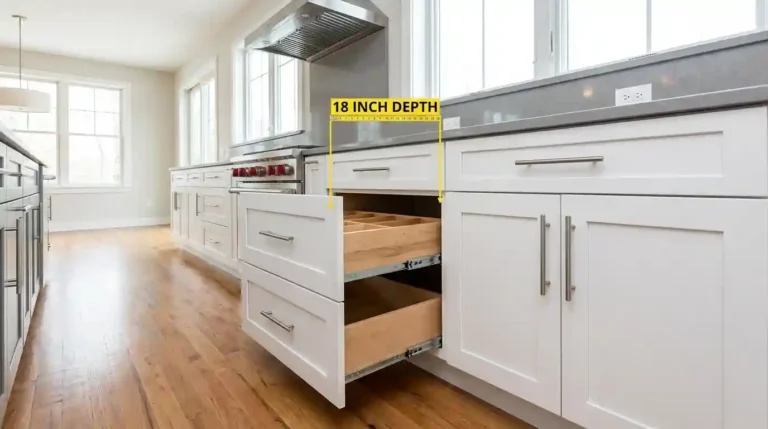
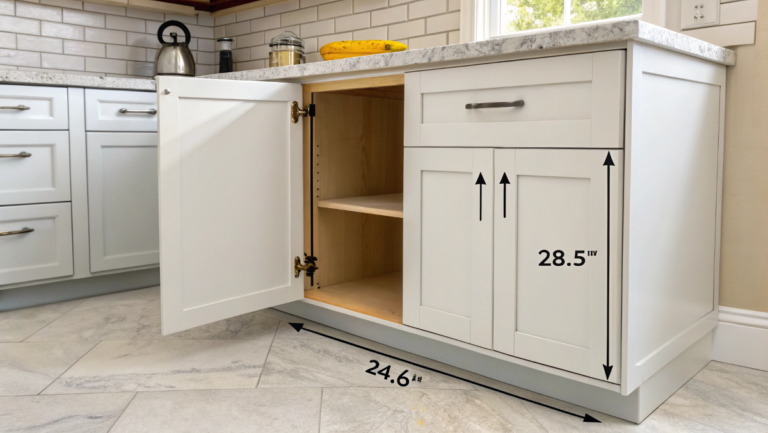
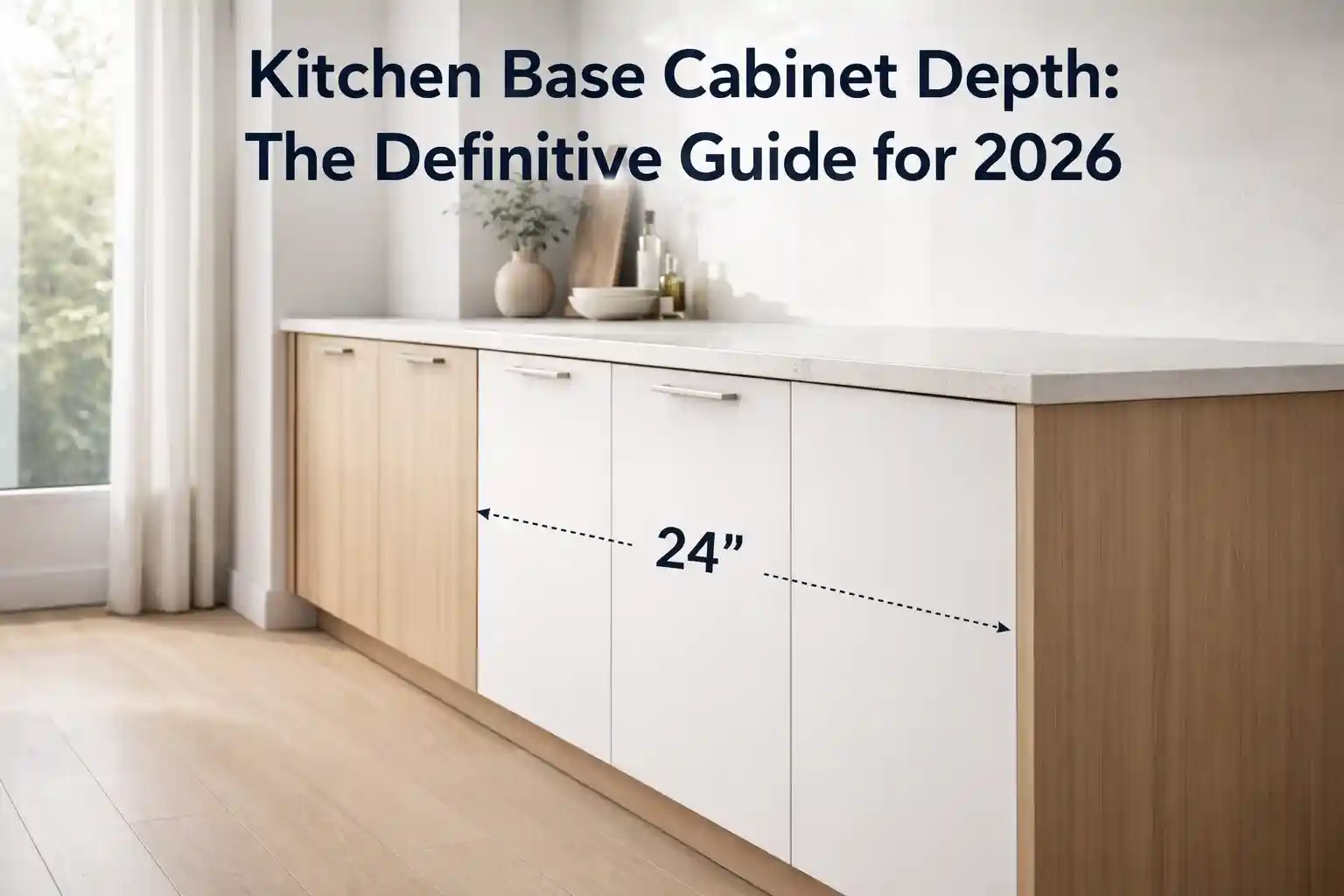
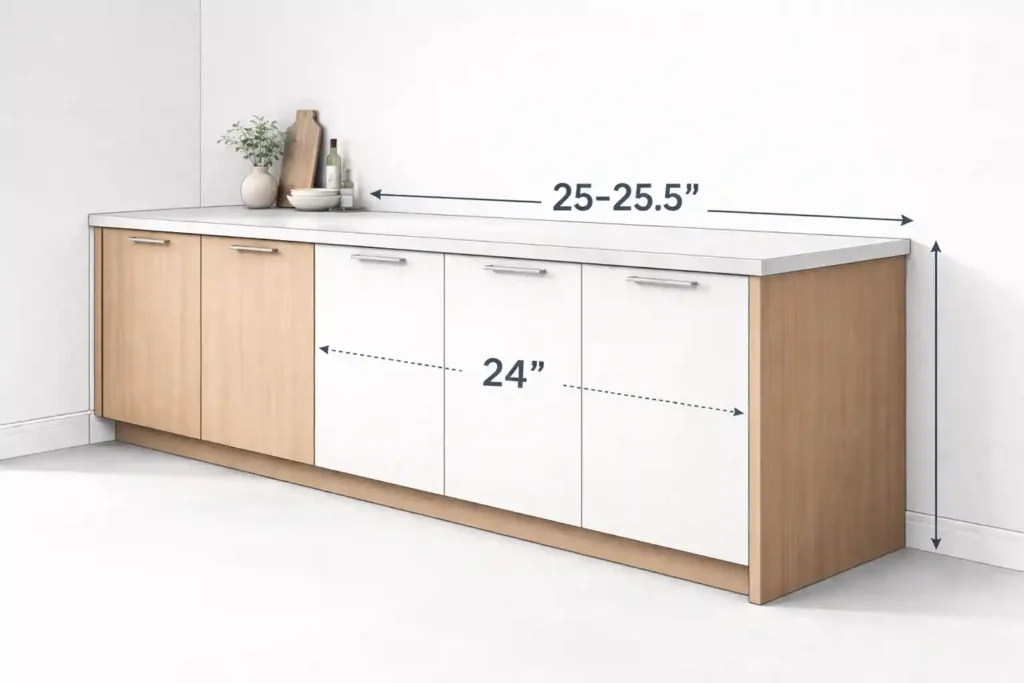
The standard kitchen base cabinet depth is 24 inches (61 cm), measured from the front face frame to the back panel, not including the countertop overhang. With a standard 1–1.5 inch countertop overhang, total depth from wall to counter edge runs approximately 25–26 inches. Shallow base cabinets (18–21″) serve small kitchens and ADA-compliant layouts, while custom depths up to 30″ accommodate professional appliances and oversized sinks.
Getting cabinet depth right isn’t a footnote in your remodel plan; it determines whether your dishwasher fits, whether two cooks can pass each other without turning sideways, and whether you’ll be straining to reach the back of every shelf for the next 20 years. This guide covers every depth option, every appliance compatibility issue, every layout scenario, and every cost consideration you need to make the right call the first time.
What Is Kitchen Base Cabinet Depth? And Why It Matters
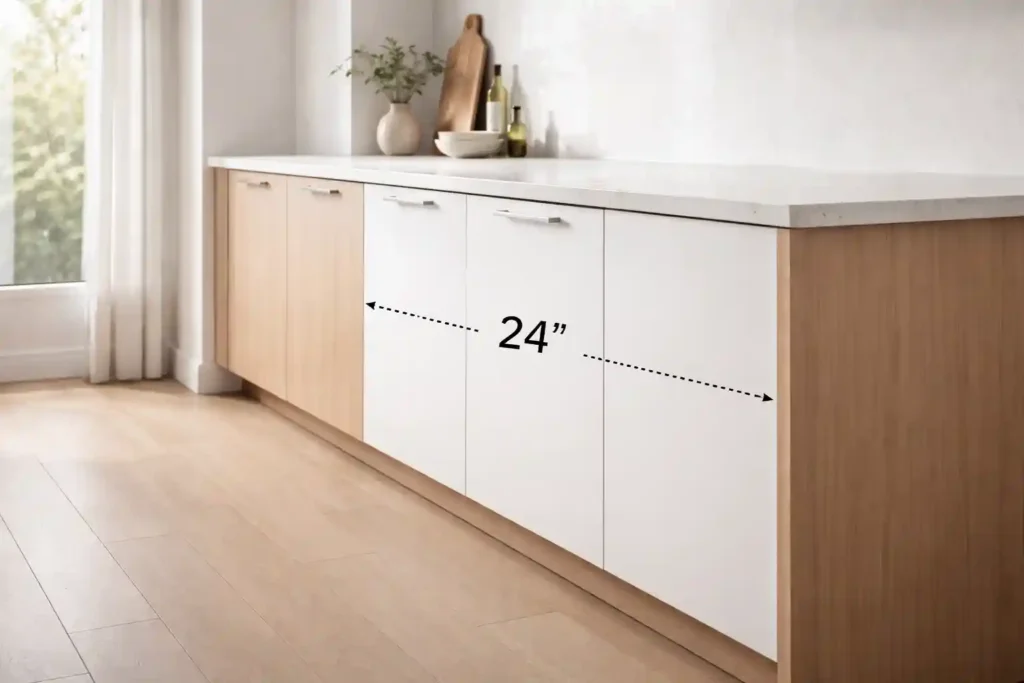
Cabinet depth is the measurement from the front of the cabinet — the face frame on American-style cabinets, or the door edge on frameless European-style — to the back panel. It does not include the countertop, the door itself when open, or any hardware extending beyond the face.
This single dimension touches almost every aspect of your kitchen’s function:
- Storage capacity: A 24″ cabinet holds significantly more than an 18″ one — roughly 25% more usable volume per linear foot.
- Ergonomics: Deeper cabinets mean more reaching. Shorter users struggle more with items at the back of a 24″ shelf without pull-outs.
- Appliance compatibility: A standard dishwasher requires exactly 24″ of depth. A standard range is designed for it. Go shallower, and you’ve disqualified yourself from most stock appliances.
- Traffic flow: Every inch of cabinet depth is an inch taken from your kitchen aisle. In a narrow galley, 24″ on one side versus 21″ on the other can be the difference between a functional workspace and a daily frustration.
- Resale value: Non-standard depths can flag as a quirk to buyers and complicate future appliance replacement.
Standard Kitchen Base Cabinet Depth: The 24-Inch Industry Standard
The 24-inch depth didn’t happen by accident. It evolved through appliance manufacturers, cabinet makers, and industry bodies converging on a dimension that works for most people and most kitchens.
Here’s why 24 inches stuck:
- Appliance manufacturers standardized around it. When dishwashers, ranges, and refrigerators were mass-produced at scale in the mid-20th century, cabinet depth and appliance depth synchronized at 24 inches. Today, changing that standard would require redesigning an entire category of products.
- It suits the average human reach. The average person can comfortably reach approximately 24–26 inches forward at counter height without significant forward lean or shoulder strain.
- It supports the countertop properly. A 24-inch cabinet box with a standard 25–25.5 inch countertop slab creates the 1–1.5 inch overhang that protects cabinet faces from drips and allows comfortable hip-to-counter positioning.
The 24-inch standard is recognized by the National Kitchen & Bath Association (NKBA) and the Kitchen Cabinet Manufacturers Association (KCMA) as the baseline for kitchen planning purposes.
Interior vs. Exterior Depth — What’s the Actual Usable Space?
This is the measurement most articles skip, and it’s the one that bites you during installation.
A cabinet with a 24″ exterior depth does not give you 24″ of usable interior storage. Here’s where the depth goes:
| Component | Thickness Consumed |
|---|---|
| Back panel | 1/4″ to 1/2″ |
| Face frame (American-style) | 3/4″ on front, reduces opening |
| Door (when closed) | Not subtracted from the interior, but limits opening access |
| Usable interior depth | ~22.5″ to 23″ |
Frameless (European/full-access) cabinets eliminate the face frame, giving you approximately 1/2″–3/4″ more usable interior width and depth per cabinet — one reason they’re popular in modern and contemporary kitchen designs.
Total Depth with Countertop Overhang
Add the countertop and the math changes again:
- Base cabinet box: 24″
- Standard countertop overhang: 1″ to 1.5″
- Total depth from wall to counter edge: ~25″ to 25.5.”
- Backsplash tile thickness (if tiled before cabinet installation): Reduces effective counter depth by 1/4″ to 3/4″
Always measure at multiple points along your wall before ordering. Older homes regularly have walls that are out of plumb by 1/2″ or more, which directly affects how cabinets sit and how countertops overhang.
All Kitchen Base Cabinet Depth Options (12″ to 30″)
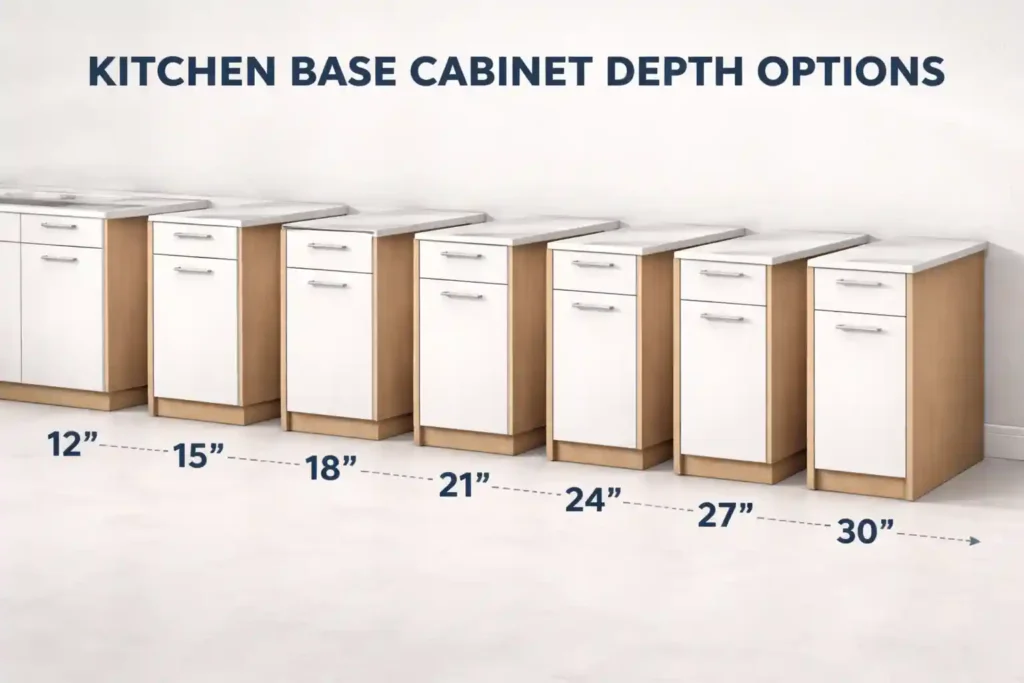
Most articles treat 24 inches as the only answer. It isn’t. Here’s the full range and when each makes sense.
Shallow Base Cabinets (12″–18″ Deep)
Shallow base cabinets solve specific problems and have been gaining traction — industry data indicates approximately a 15% increase in shallow cabinet sales between 2024 and 2025, driven by compact urban kitchens, open-plan designs, and aging-in-place remodels.
Best uses for 12″–18″ base cabinets:
- The back (seating) side of a kitchen island
- Peninsula lower cabinets on the living room-facing side
- Galley kitchen where 24″ on both sides creates an aisle too narrow to code
- ADA-accessible kitchen sections (max 19″ depth for wheelchair knee clearance)
- Dining room hutch-style lower cabinets
- Laundry rooms and mudroom benches
Trade-off: You cannot install a standard 24″ dishwasher in a section using cabinets shallower than 24″.
Reduced-Depth Base Cabinets (21″ Deep)
The 21-inch option is the middle ground that gets overlooked. It recovers 3″ of aisle width compared to standard depth — exactly the gap between a frustratingly tight galley and a workable one — while sacrificing less storage than going to 18″.
Good candidate for: one side of a galley under 10 feet wide, a peninsula where seating is on the other side, or a run of base cabinets that doesn’t need to house appliances.
Standard-Depth Base Cabinets (24″ Deep)
The default choice for good reason. Every standard appliance fits. Every stock countertop slab fits. Every stock hardware pull and hinge is designed around it. If your kitchen layout supports 24″ on all sides with adequate aisle space (see below), this is your answer.
Deep Base Cabinets (27″–30″ Deep)
Used in specific scenarios:
- Professional/commercial-style ranges that project 1″–3″ beyond the standard counter line
- Extra-deep single-basin sinks (particularly farmhouse/apron sinks over 10″ deep)
- Dedicated prep zones where a deeper countertop workspace is intentional — think a baker’s workstation
- Back-of-island cabinetry where extra depth adds concealed storage without affecting aisle width
KraftMaid and several semi-custom manufacturers offer 27″ as a standard upsell option. Beyond 27″, you’re into full custom territory. Note that deep cabinets without pull-out organizers become functionally useless past about 20″ — items disappear into the back and stay there.
Kitchen Base Cabinet Depth by Cabinet Type
The 24-inch standard applies broadly but isn’t universal across every cabinet style.
Sink Base Cabinet Depth
Sink base cabinets are the same 24″ box depth, but the interior is modified significantly:
- No bottom shelf — the plumbing stub-out takes that space
- The rear panel may be cut or drilled for pipe access
- Face-frame modification required for apron/farmhouse sinks, since the front of the apron projects past the face frame by 1″–3.5″, depending on the sink depth
Drop-in sinks sit entirely within the cabinet box and require no modification to depth. Undermount sinks require the countertop to overhang the sink slightly; it still works at the standard 24″ depth. Farmhouse sinks are the most demanding — the sink’s apron front replaces the cabinet’s face frame in that section, and the base cabinet opening must be cut to match the sink’s specific apron dimensions.
Corner Cabinet Depth
Corner cabinets are measured differently because they exist at the junction of two cabinet runs:
| Corner Type | Effective Depth | Notes |
|---|---|---|
| Blind corner | 24″ where it meets the adjacent run | Dead space extends 24″–30″ into the corner |
| Lazy Susan | 24″ at openings; 33″–36″ circular tray diameter | Requires a 36″ opening on each adjacent wall |
| Corner drawer unit | 24″ exterior | Special drawer mechanism required |
| Open corner shelf | 12″–18″ | Purely display; no appliance installation |
The dead space in blind corners is unavoidable without a Lazy Susan or a pull-out corner system (Magic Corner style). Budget $150–$500 for pull-out corner hardware if you want to recover that space.
Kitchen Island Cabinet Depth
Islands follow different rules from perimeter cabinets because they’re accessible from multiple sides:
- Working/cooking side: 24″ standard, to align with appliances (cooktop, prep sink, undercounter fridge)
- Seating/opposite side: 12″–18″, providing structural support without blocking knee space at bar stools
- Back-to-back 24″ runs: Creates a 48″ deep island before countertop — typical for large open-plan kitchens
- Bar seating overhang: Add 10″–15″ countertop overhang over the seating side for comfortable legroom; stool seat height determines whether you need a 36″ or 42″ counter height on the seating side
Total island depth, including countertop overhang on both sides of a standard back-to-back build: approximately 50″–52″.
Drawer Base Cabinet Depth
Same 24″ exterior box as a standard base, but the internal configuration changes the functional equation:
- Fixed shelf configuration: Access limited to approximately 16″ without pulling items forward
- Full-extension drawer (100%): Entire drawer comes out, giving access to all ~22″ of interior depth
- Soft-close full-extension drawers: Standard in most semi-custom and custom lines today
Drawer bases are frequently the smarter choice over door-and-shelf bases,s specifically because they eliminate the reach problem. Three-drawer base cabinets are ideal for pots, pans, and heavy items.
How Kitchen Base Cabinet Depth Interacts with Appliances
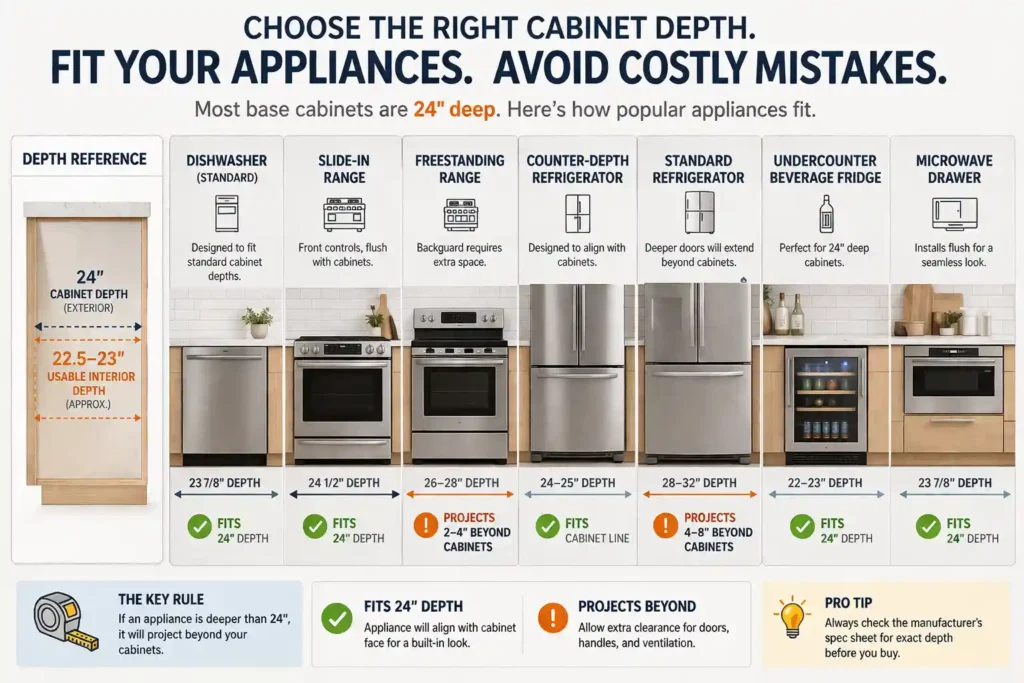
This is the section that prevents expensive mistakes. Appliance depth requirements are largely non-negotiable — the appliance is what it is.
| Appliance | Required Cabinet Depth | Consequence of Mismatch |
|---|---|---|
| Standard dishwasher (24″) | 24″ minimum | Cannot install at all if shallower |
| Slide-in range | 24″ | Designed to overlap countertop edge — fits standard depth |
| Freestanding range | 24″–26″ | May protrude 2″–3″ past the counter if the cabinet is only 24″ |
| Professional/dual-fuel range | 24″–27″ | Often projects 1″–3″ past the counter line |
| Counter-depth refrigerator | 24″–25″ | Aligns flush with standard 24″ counter run |
| Standard refrigerator | 30″–36″ | Projects 6″–12″ past cabinet line; requires panel or build-out |
| Under-counter microwave drawer | 24″ | Standard fit; check unit specs for height clearance |
| Undercounter wine/beverage fridge | 24″ | Standard fit |
| Undercounter ice maker | 15″–24″ | Check specific unit — some are 15″ or 18″ deep |
Counter-Depth vs. Standard-Depth Refrigerators
Counter-depth refrigerators became popular because they don’t project past the cabinet line — they create a built-in look without the custom surround cost of a true built-in unit. They work at a standard 24″ cabinet depth with no modification.
The trade-off: counter-depth fridges sacrifice approximately 20%–25% of interior cubic footage compared to their full-depth counterparts at the same door width. A 36″ counter-depth unit might offer 20–22 cu. ft., where a 36″ full-depth unit offers 26–28 cu. ft.
For the cabinet surround above the refrigerator, standard practice is to run 24″ upper cabinets (matching base cabinet depth) rather than standard 12″ wall cabinets, to create a built-in appearance.
Dishwasher Depth Requirements
This is not flexible. A standard built-in dishwasher is 24″ deep (plus a few millimeters for installation tolerance). The surrounding base cabinets on each side must be 24″ deep. You cannot reduce the cabinet depth in a dishwasher section to 21″ or 18″ without either eliminating the dishwasher or using a countertop-mount/drawer dishwasher as a substitute.
Compact 18″ dishwashers are available for apartment kitchens and are only 18″ deep — these can fit in shallower cabinet sections.
Range and Cooktop Depth Alignment
Slide-in ranges are specifically designed to sit between two 24″ base cabinet runs, with the cooktop surface overlapping the adjacent countertop slightly. This creates the clean, restaurant-style line that makes them popular. They require 24″ depth on both flanking cabinets.
Freestanding ranges are more flexible — they stand independent of adjacent cabinets — but if the cabinet depth is 24″ and the range is 26″ deep, the range will project 2″ past the counter line. This is usually acceptable,e but worth knowing in advance.
Standard vs. Custom Kitchen Base Cabinet Depth
Stock Cabinets (Fixed Depths)
Stock cabinets from big-box stores (Home Depot’s Hampton Bay, IKEA SEKTION, Lowe’s Style Selections) are available almost exclusively at 24″ depth for base cabinets. There is no “order a different depth” option — what’s on the shelf is what you get.
IKEA note: IKEA SEKTION base cabinets are 24-3/4″ in exterior depth — slightly deeper than the U.S. standard 24″. This matters when aligning with adjacent non-IKEA appliances or cabinets, and when calculating countertop dimensions.
Stock cabinets are the most affordable entry point: $100–$350 per linear foot installed, depending on cabinet style and region.
Semi-Custom Cabinets (Modified Depths)
Semi-custom lines (KraftMaid, Diamond, Merillat, Fabuwood, Waypoint) offer more flexibility:
- Available depths typically include 12″, 15″, 18″, 21″, 24″, and sometimes .27″
- Modifications can be ordered in 1/16″ increments through special order with some manufacturers
- Lead time increases to 4–8 weeks vs. in-stock availability for standard depth
Semi-custom cost range: $200–$650 per linear foot installed. Ordering a non-standard depth typically adds $50–$150 per cabinet box, not per linear foot.
Full Custom Cabinets (Any Depth)
A custom cabinet shop will build any depth from 12″ to 30″+ to your exact specifications. You can mix depths within the same kitchen — 24″ on the perimeter, 27″ at a pro-range section, 18″ on the island seating side — without any constraints.
Full custom cost range: $500–$1,500+ per linear foot installed. The upper end reflects complex designs, premium wood species, and urban markets. Depth modification alone does not significantly increase custom cabinet cost compared to other customizations (inset doors, special finishes, unusual hardware routing).
Cost Comparison: Standard vs. Custom Depth
| Cabinet Type | Typical Installed Cost (per linear foot) | Depth Options |
|---|---|---|
| Stock | $100–$350 | 24″ only (base) |
| Semi-custom | $200–$650 | 12″–27″ |
| Full custom | $500–$1,500+ | Any depth |
| Semi-custom depth upcharge | +$50–$150/cabinet | Per non-standard box |
How to Choose the Right Base Cabinet Depth for Your Kitchen
Measure Your Kitchen Space First
Before selecting any cabinet depth, measure your kitchen thoroughly. Here’s how:
- Measure wall-to-wall at multiple heights — 6 inches from the floor, 36 inches (counter height), and 54 inches. Walls are rarely perfectly plumb or parallel.
- Note all obstructions — electrical outlets, plumbing stub-outs, windows, and HVAC vents all affect cabinet placement and potential depth.
- Calculate your aisle widths by subtracting the total cabinet depth on both sides from the wall-to-wall measurement.
NKBA minimum aisle width guidelines:
- 36 inches: Absolute code minimum for a single-cook kitchen
- 42 inches: Recommended for a single cook
- 48 inches: Required for two cooks working simultaneously
If your galley kitchen is 96″ wide and you run 24″ cabinets on both sides plus a 36″ countertop height, you have 96″ – 48″ = 48″ of aisle space. Adequate for two cooks. If the kitchen is 84″ wide, reducing one side to 21″ recovers 3″ and keeps you at a workable 45″ aisle.
Match Depth to Your Kitchen Layout
| Layout | Depth Recommendation |
|---|---|
| Galley (under 9′ wide) | 21″ on one side, 24″ on the other |
| Galley (9’–10′ wide) | 24″ on both sides |
| L-shaped | 24″ standard throughout |
| U-shaped | 24″ standard; check aisle between parallel runs |
| G-shaped | 24″ standard; consider 21″ on peninsula if aisle is tight |
| Open-plan with island | 24″ perimeter; 12″–18″ on island seating side |
Consider Ergonomics and User Height
The 24-inch standard was built around an average user height of roughly 5’6″–5’10”. At this height, the natural reach zone extends about 24″ forward at counter height without forward lean.
Shorter users (under 5’4″) will find the back 4″–6″ of a standard 24″ base cabinet genuinely hard to reach comfortably, especially at the floor level of lower shelves. The solution isn’t necessarily shallower cabinets — it’s pull-out trays and drawer bases, which bring the contents forward to you rather than requiring you to reach back into the cabinet.
ADA and Accessibility Depth Requirements
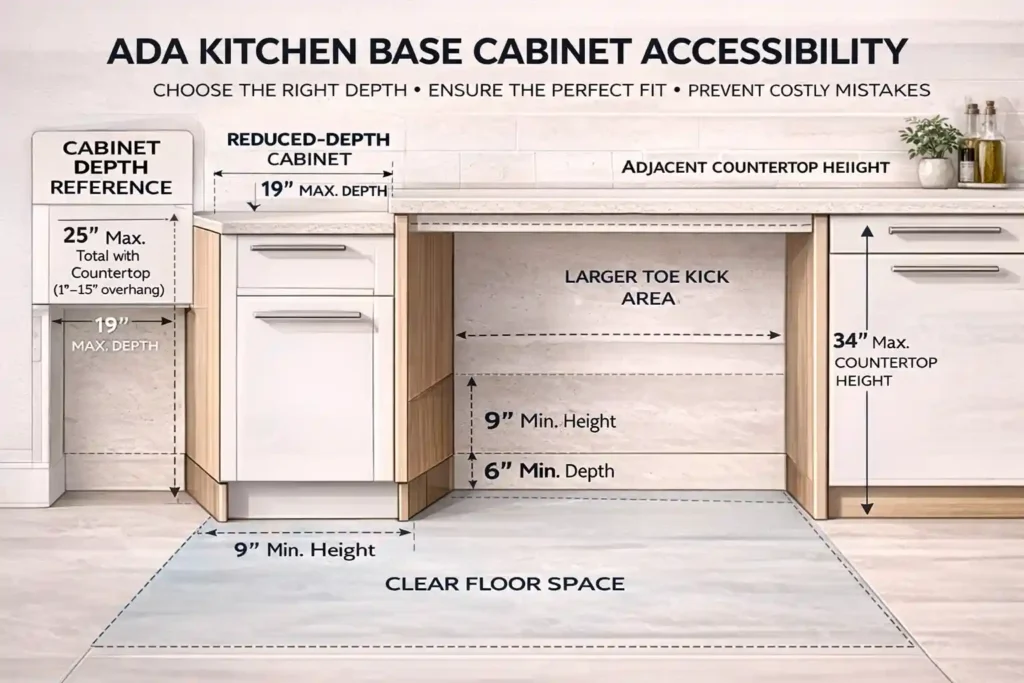
For kitchens designed for wheelchair users or aging-in-place purposes, the ADA Standards for Accessible Design specify:
- Maximum base cabinet depth for wheelchair knee clearance: 19 inches
- Toe kick dimensions: At least 9 inches high × 6 inches deep (larger than standard) for wheelchair footrest clearance
- Counter height: Maximum 34 inches (versus standard 36 inches)
- Clear floor space: 30″ × 48″ adjacent to appliances for approach
These requirements often mean one section of base cabinets is reduced to 18″ depth, leaving a knee-clearance zone beneath the counter. The flanking cabinets can remain 24″ standard depth.
Kitchen Base Cabinet Depth and the Kitchen Work Triangle
The classic kitchen work triangle connects the refrigerator, cooktop, and sink — the three primary work stations. Cabinet depth affects the triangle indirectly but meaningfully: deeper cabinets on perimeter walls shorten the aisle distance between work stations, which affects how efficiently the triangle functions.
NKBA guidelines specify that no single leg of the work triangle should exceed 9 feet, and the total perimeter shouldn’t exceed 26 feet. When base cabinets are particularly deep — say, 27″ on a professional-range run — the walkway between that station and the island or opposing wall narrows, and you may find the triangle’s effective distances compressed.
The 3×4 Kitchen Rule
The 3×4 rule recommends three distinct work zones — cooking, cleaning, and food prep — each with approximately 4 feet (48 inches) of counter space. Each zone’s counter is supported by base cabinets underneath. Getting the depth right in each zone matters:
- Cooking zone: 24″ minimum to accommodate a standard range
- Cleaning zone (sink): 24″ standard; check sink type before ordering (farmhouse sinks require specific modifications)
- Prep zone: 24″ is standard, but a dedicated baking zone might justify 27″ for extra counter depth
Toe Kick Dimensions and How They Relate to Cabinet Depth
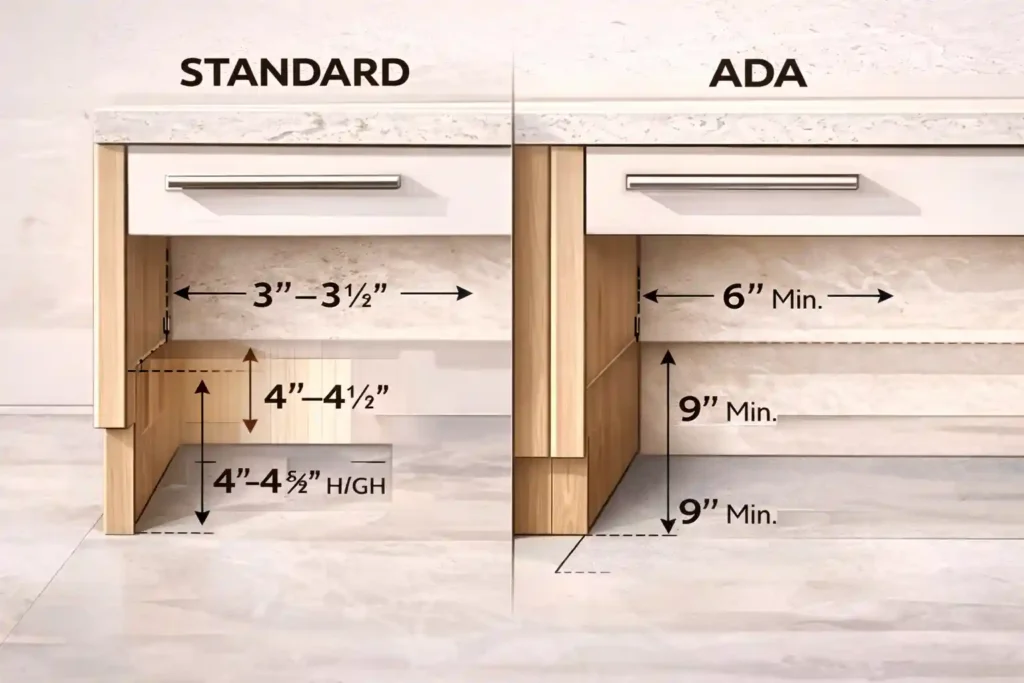
The toe kick is the recessed section at the bottom front of a base cabinet — the space your toes slide under when you stand at the counter. It’s easy to ignore in planning and painfully obvious when it’s wrong.
Standard toe kick dimensions:
- Depth: 3 to 3.5 inches
- Height: 4 to 4.5 inches
These dimensions allow most adults to stand comfortably close to a 36-inch counter without leaning forward significantly. Without a properly sized toe kick, you’d be forced to stand 3–4 inches back from the counter, dramatically increasing the reach required to use the full 24″ cabinet depth.
ADA toe kick dimensions:
- Depth: 6 inches minimum
- Height: 9 inches minimum
The deeper, taller ADA toe kick allows wheelchair footrests to slide under the counter, enabling a user to pull up close enough to work comfortably within the accessible counter depth.
When ordering custom or semi-custom cabinets for a kitchen with an unusual floor-to-ceiling height or a decorative base treatment, confirm the toe kick dimensions separately — they’re sometimes specified independently of the cabinet box.
Wall Cabinet and Tall Cabinet Depths: Quick Reference
Wall Cabinet Depth (12″ Standard)
Upper wall cabinets are 12 inches deep as standard. This keeps cabinet faces roughly aligned with the front edge of the countertop below, leaving working space at the counter without constantly ducking under open doors.
The exception: upper cabinets above the refrigerator are typically 24 inches deep to create the built-in surround look.
Tall/Pantry Cabinet Depth
Pantry and tall cabinets come in two depths:
- 12 inches: For a “hutch” style pantry, displayed items, or shallow pantry storage
- 24 inches: For a full pantry or utility cabinet that stores larger items, a built-in oven, or a microwave
Most floor-to-ceiling pantry cabinets used in place of a walk-in pantry are 24″ deep.
Complete Cabinet Depth Reference Table
| Cabinet Type | Standard Depth | Common Alternatives |
|---|---|---|
| Base cabinet | 24″ | 12″, 15″, 18″, 21″, 27″, 30.” |
| Wall/upper cabinet | 12″ | 15″, 24″ (over fridge) |
| Tall/pantry cabinet | 24″ (full) or 12″ (shallow) | 18″ |
| Island working side | 24″ | 27″ (pro appliance runs) |
| Island seating side | 12″–18″ | — |
| Corner base cabinet | 24″ at opening | — |
| ADA base cabinet | ≤19″ | — |
European (Metric) vs. American Cabinet Depths
U.S. cabinet manufacturers work in inches. European manufacturers work in millimeters. They don’t land on the same number.
| Standard | Depth |
|---|---|
| U.S./North American | 24 inches (610 mm) |
| European (DIN standard) | 560–600 mm (22″–23.6″) |
| IKEA SEKTION (U.S. market) | 24-3/4″ exterior (629 mm) |
The discrepancy matters if you’re:
- Mixing IKEA cabinets with American brand cabinets in the same run (they won’t align flush)
- Importing European cabinets for a European-style kitchen
- Installing appliances designed for European dimensions in a U.S. kitchen (less common, but relevant in the luxury segment imports)
IKEA’s U.S. SEKTION line is calibrated to approximate the American standard while using metric manufacturing. In practice, the extra 3/4″ on IKEA base cabinets rarely causes problems — countertop slabs accommodate the slight difference — but it’s worth noting when planning a mixed-source kitchen.
Pro Tips: Maximizing Storage in Standard-Depth Base Cabinets
Getting the most from a 24″ depth means thinking about access, not just volume.
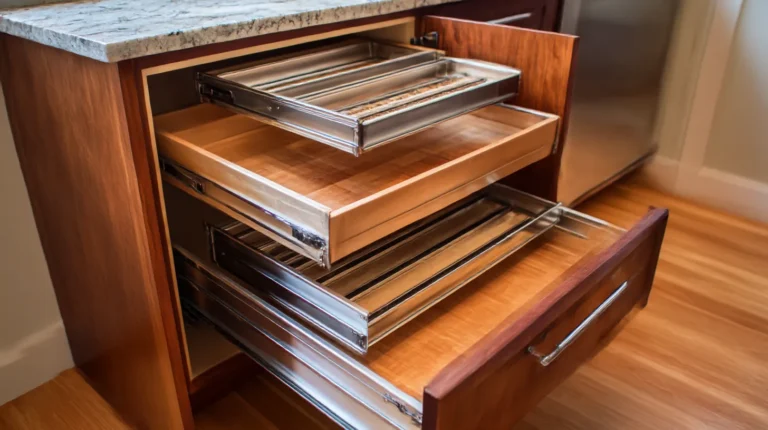
Pull-out trays and rollout shelves — The single highest-impact upgrade for base cabinets. A full-extension rollout shelf brings everything in a 24″-deep cabinet to the front of the opening. Studies from storage organization firms suggest that rollout shelves increase usable cabinet capacity by 30–40% simply by making rear contents accessible.
Drawer bases over door-and-shelf bases — For pots, pans, mixing bowls, and other heavy items, a 3-drawer base cabinet beats a door-and-shelf base every time. You see and access everything without kneeling or bending.
Lazy Susans for corners — A full-circle or kidney-shaped Lazy Susan recovers approximately 50% of the otherwise dead corner space.
Vertical dividers — A 24″-deep base cabinet with vertical dividers stores baking sheets, cutting boards, and trays standing upright, accessible in seconds rather than buried horizontally under other items.
Under-sink organizers — The sink base is one of the most wasted spaces in most kitchens. Door-mounted organizers, pull-out bins, and tension-rod drip-dry systems recover meaningful space in a cabinet that would otherwise be an awkward dump zone for cleaning supplies.
Tip-out drawer fronts — Install a false drawer front below the sink as a tip-out tray for sponges and brushes. Recovers 2–3 inches of depth in a spot that’s otherwise wasted.
Common Mistakes to Avoid with Kitchen Base Cabinet Depth
Forgetting hardware depth. A cabinet door with a large pull or knob extends 1″–2″ past the face frame when the door is closed. In a tight galley, the effective aisle-blocking depth of your cabinets is the box depth plus the hardware projection. With a 1.5″ knob, your 24″ cabinet effectively occupies 25.5″ of floor space.
Not measuring at multiple wall points. Ordering cabinets to a single wall measurement and discovering a 3/4″ variance at one end is a common and expensive mistake in older homes.
Ignoring the countertop overhang in your depth calculations. If you’re calculating whether a refrigerator will clear the counter edge when the door opens, use the 25.5″–26″ total depth figure, not the 24″ cabinet box depth.
Choosing deeper cabinets without pull-outs. A 27″ or 30″ deep cabinet with fixed shelves is worse than a 24″ deep cabinet with rollout shelves. More depth only helps if you can access all of it.
Using standard depth in a too-narrow galley. If your wall-to-wall measurement is under 96 inches, 24″ on both sides leaves only 48″ of aisle — workable but ungenerous. Under 90″, you need to reconsider depth on at least one side.
Ordering without checking appliance specs. Appliance depths vary by brand and model more than most people expect. A 36″ wide professional range might be 27″ deep, where a standard 30″ range is 25.5″. Check the spec sheet for every appliance before finalizing cabinet depths.
Not accounting for the acksplash in countertop depth. Tile backsplash installed before countertop placement reduces effective counter depth by the tile thickness (3/8″–3/4″ for standard tile). When tight on depth, tile after countertop installation, and account for this in your design sequence.
Frequently Asked Questions
Are all kitchen base cabinets 24 inches deep?
No. While 24 inches is the industry standard in North America, base cabinets are manufactured in depths from 12 inches to 30 inches. Shallow options (12″–21″) serve small kitchens, island seating sides, and ADA-accessible sections. Deep options (27″–30″) accommodate professional appliances and specialized workstations. The 24-inch depth is simply the most universally compatible and widely stocked size.
Can base cabinets be less than 24 inches deep?
Yes. Shallow base cabinets are available in 12″, 15″, 18″, and 21″ depths from semi-custom and custom cabinet manufacturers. They’re commonly used in galley kitchens with tight aisles, on the seating side of kitchen islands, and for ADA-accessible kitchen sections. Keep in mind that you cannot install a standard 24″ built-in dishwasher in any cabinet run shallower than 24″.
How deep is a regular base cabinet?
A standard base cabinet is 24 inches deep, measured from the face frame to the back panel. Adding a standard countertop with a 1–1.5 inch overhang brings total depth from wall to counter edge to approximately 25–26 inches. Due to back panel thickness (1/4″–1/2″) and the face frame, usable interior depth is approximately 22.5″–23″.
Do they make 24-inch-deep base cabinets?
Yes — 24 inches is the standard depth offered by virtually every cabinet manufacturer, from stock lines (IKEA, Hampton Bay, Kraftmaid stock) to semi-custom and full custom shops. It’s the most widely available, most affordable, and most universally compatible depth option on the market.
What is the 1/3 rule for cabinet hardware?
The 1/3 rule is a design proportion guideline: your drawer pull should be approximately one-third the width of the drawer face, and a door pull should be approximately one-third the height of the door. This creates visually balanced hardware proportions. For example, a 30-inch wide drawer works well with a 10-inch bar pull, and a 30-inch tall door pairs well with a 10-inch pull centered on the door.
What is the 3×4 kitchen rule?
The 3×4 rule recommends three distinct kitchen work zones — cooking, cleaning, and food prep — each with approximately 4 feet (48 inches) of counter workspace. Each zone needs appropriately sized base cabinets beneath it: 24″ depth for standard zones, potentially 27″ for a dedicated pro cooking or baking zone. The rule ensures adequate workspace for each kitchen function without zones bleeding into each other.
What is the most common depth for base cabinets in kitchens?
24 inches is the universal standard in North America. It’s the depth recognized by NKBA planning guidelines, manufactured by every stock and semi-custom cabinet brand, and compatible with standard dishwashers, ranges, sinks, and counter-depth refrigerators.
How deep should base cabinets be for a kitchen island?
For the primary working side, 24 inches matches perimeter cabinets and accommodates any undercounter appliance. The seating side typically uses 12″–18″ depth. Back-to-back 24″ cabinet runs create a 48″ deep island box before the countertop is added. For bar seating, plan a 10″–15″ countertop overhang on the seating side for comfortable knee clearance.
What is the minimum aisle width between kitchen cabinets?
The NKBA minimum aisle width is 36 inches (absolute code floor for a single-cook kitchen), with 42 inches recommended for a solo cook and 48 inches recommended for a two-cook household. If your kitchen falls short, reducing base cabinet depth from 24″ to 21″ on one side recovers 3 inches of aisle width — often enough to meet the guideline.
Do kitchen cabinet depths differ between American and European brands?
Slightly. U.S. standard base cabinet depth is 24 inches (approximately 610 mm). European base cabinets follow the DIN standard of 560–600 mm (approximately 22″–23.6″). IKEA’s U.S.-market SEKTION base cabinets are 24-3/4″ in exterior depth — marginally deeper than the American standard. This matters primarily when mixing IKEA cabinets with American-brand cabinets in the same run, or when installing European-market appliances designed for 60 cm cabinet depth.
Final Takeaway: Getting Kitchen Base Cabinet Depth Right
Cabinet depth is one of those decisions that gets made once and lived with for 15–20 years. The 24-inch standard exists because it works for most kitchens, most appliances, and most people. But “standard” is a starting point, not a mandate.
If your kitchen is narrow, 21″ on one side is not a compromise — it’s a deliberate upgrade to your daily life. If you’re installing a professional range, confirming the depth of your cabinet run against that specific appliance’s specs is a 10-minute task that prevents a permanent problem. If you’re designing for accessibility, the depth is a code requirement with no workaround.
Measure your space at multiple points. Pull the spec sheets on your appliances before ordering cabinets. Think about who uses the kitchen, how they reach, and what you’re actually storing — then match the depth to those answers, not just to the catalog default.
For authoritative kitchen planning standards, see the NKBA Kitchen Planning Guidelines and ADA Standards for Accessible Design. Cabinet manufacturer specifications vary — always confirm dimensions directly with your supplier before ordering.