Inset Kitchen Cabinets. Complete Guide, Costs & Styles
If you’ve been dreaming of a kitchen that feels custom-built and effortlessly elegant, inset kitchen cabinets deserve a top spot on your mood board. Unlike standard overlay doors that sit on top of the frame, inset doors and drawers tuck neatly inside it, delivering that coveted furniture-quality finish you see in high-end design magazines.
In this guide, I’m walking you through everything, from costs and design styles to hardware, lighting, paint colors, and maintenance, so you can confidently decide if inset cabinetry is the right investment for your US kitchen remodel.
What Are Inset Kitchen Cabinets?
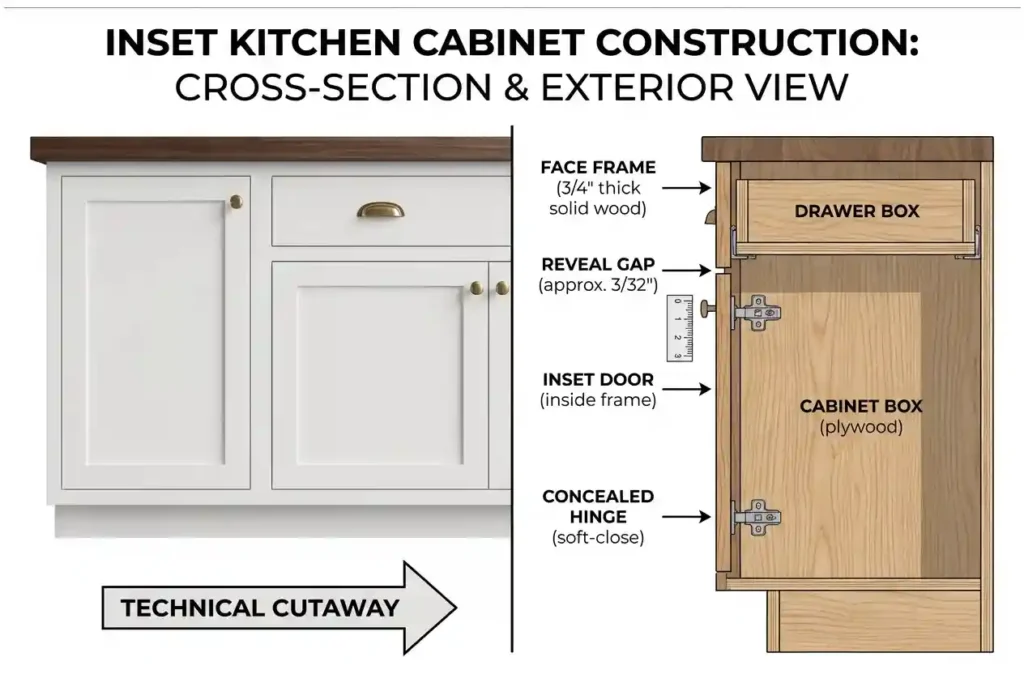
At its core, an inset cabinet is defined by one simple detail: the door and drawer fronts sit completely flush inside the face frame, rather than overlapping it. This creates a sleek, tailored appearance with a uniform 3/32″ reveal gap running around every door and drawer, a hallmark of precision woodworking.
That tiny gap isn’t just decorative. It allows the doors to open and close smoothly without rubbing against the frame, while still maintaining that tight, custom-fitted look. Think of it like a perfectly tailored suit, every edge lines up, nothing overlaps, and the craftsmanship speaks for itself.
Inset cabinetry has deep roots in American furniture-making traditions, dating back to early Colonial and Shaker design. Today, it’s experiencing a major resurgence in kitchens across the US, from historic brownstones in Boston to new-construction homes in Austin. Designers and homeowners alike are drawn to its timeless versatility; it looks equally stunning in a classic Colonial kitchen, a modern farmhouse, or a sleek contemporary space.
How Inset Cabinets Differ From Overlay and Frameless Cabinets
One of the most common questions I hear is: “What’s the actual difference between inset, overlay, and frameless cabinets?” Let’s break it down clearly.
-
Inset cabinets have doors and drawers that sit inside the face frame, flush with its surface. The frame is fully visible, and the signature 3/32″ gap provides a furniture-grade finish.
-
Full overlay cabinets feature doors that sit on top of the face frame, covering nearly all of it. Only about 1/4″ of the frame is visible between doors. This is the most common style in US kitchens today.
-
Partial overlay cabinets also sit on top of the frame but leave more frame exposed, typically 1″–1 1/2″ between doors. This is a builder-grade standard often found in older or budget-friendly kitchens.
-
Frameless (European-style) cabinets eliminate the face frame. Doors attach directly to the cabinet box, maximizing interior storage space. Popular in modern and minimalist designs.
Here’s a side-by-side comparison to make the differences crystal clear:
| Feature | Inset | Full Overlay | Partial Overlay | Frameless |
|---|---|---|---|---|
| Door Position | Flush inside face frame | Sits on top of the frame, nearly covering it | Sits on top of the frame, more frame visible | No frame; doors mount to the cabinet box |
| Cost Range (per linear ft) | $350–$1,200+ | $150–$650 | $100–$400 | $200–$800 |
| Storage Efficiency | Slightly reduced (frame takes up interior width) | Good | Good | Best, no frame means maximum interior space |
| Best Use Case | Traditional, transitional, high-end custom kitchens | Most US kitchen styles are versatile | Budget remodels, rentals, builder-grade | Modern, minimalist, European-inspired kitchens |
| Installation Difficulty | High, requires precision alignment | Moderate | Easy | Moderate to High |
Key takeaway: Inset cabinets trade a small amount of interior storage space and budget-friendliness for unmatched visual refinement and a custom, furniture-like appearance.
Flush Inset vs. Beaded Inset: Understanding Frame Profiles
Not all inset cabinets look the same, and the difference often comes down to the frame profile. There are two main styles you’ll encounter when shopping for inset cabinetry in the US:
Flush Inset
This is the cleaner, more contemporary option. The door and drawer fronts sit perfectly flush with a flat, smooth face frame. The only visual detail is that precise 3/32″ reveal gap surrounding each door, nothing more, nothing less.
Best for: Modern kitchens, transitional spaces, Shaker-style designs, and minimalist aesthetics where you want the cabinetry to feel streamlined and understated.
Beaded Inset
With beaded inset cabinets, a small decorative bead (a rounded molding detail) is routed along the inside edge of the face frame, surrounding every door and drawer opening. This bead is typically 1/8″–3/16″ wide and adds a subtle shadow line that enhances visual depth.
Best for: Traditional kitchens, Colonial and period-style homes, cottage designs, and anyone who wants that extra layer of classic, old-world craftsmanship.
[Image Placeholder: Side-by-side annotated comparison of flush inset vs. beaded inset frame profiles, with the 3/32″ reveal gap and bead detail clearly labeled]
Both styles require the same level of precision during construction and installation. The choice between them is purely aesthetic, flush inset leans modern, a beaded inset leans traditional. Many homeowners decide by matching the frame profile to other architectural details in their home, such as crown molding, wainscoting, or fireplace mantels.
Why Homeowners Choose Inset Cabinets, Pros and Cons
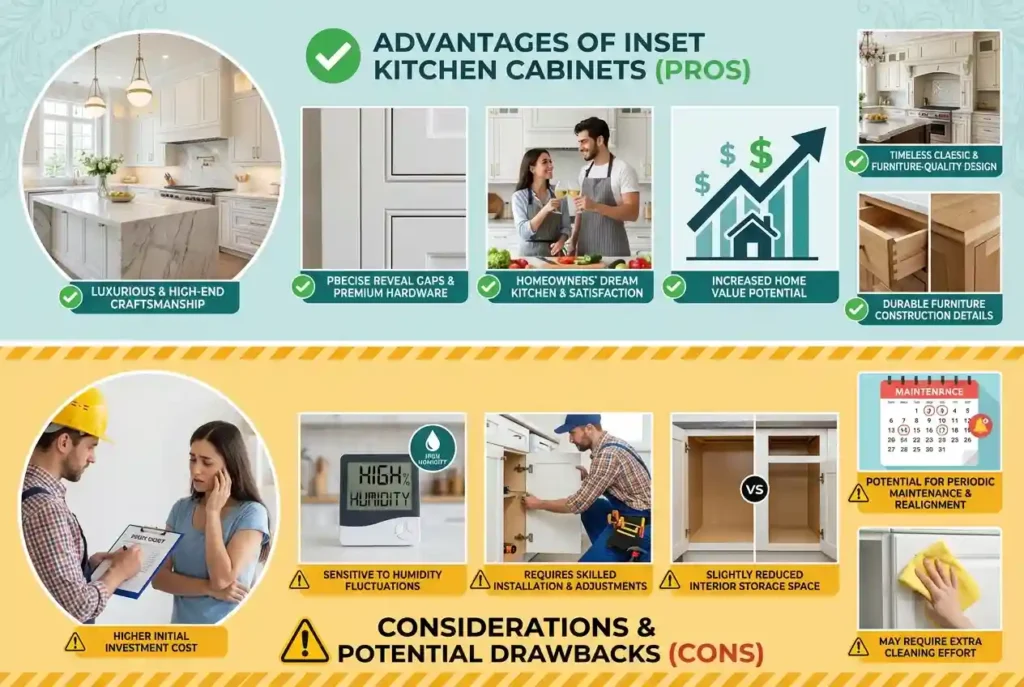
Choosing a cabinet style is one of the biggest decisions you’ll make during a kitchen remodel, and it’s not one to take lightly. Inset cabinetry is a significant investment, both financially and aesthetically, so let’s look at the full picture before you commit.
Advantages of Inset Kitchen Cabinets
There’s a reason inset cabinets have been a staple of fine American homes for centuries. Here are the key benefits that keep homeowners and designers coming back to this style:
Clean, Furniture-Like Lines The flush, precise fit of inset doors creates a seamless visual flow across your kitchen. There are no overlapping edges or uneven shadows, just smooth, tailored lines that make the entire space feel intentional and curated. It’s the closest your kitchen cabinetry will ever come to looking like a custom-built piece of heirloom furniture.
Timeless Design That Never Dates Trends come and go, but inset cabinetry has remained relevant for over two centuries. Whether your home was built in 1920 or 2025, this style fits right in. You’ll never look at your kitchen five years from now and think, “That looks dated.”
Higher Perceived Resale Value. When potential buyers walk into a kitchen with inset cabinets, the reaction is almost always the same: “This is a high-end kitchen.” That perception translates into real value. Inset cabinetry signals quality, care, and investment, all of which help your home stand out in a competitive US housing market.
Enhanced Durability From Reduced Exposure Because the doors sit inside the frame rather than on top of it, the edges are naturally protected. This means less chipping, less wear on the door edges, and less exposure to daily kitchen bumps and dings. The face frame essentially acts as a built-in bumper for every door and drawer front.
Superior Craftsmanship You Can See and Feel. There’s no faking an inset cabinet. The precision required to maintain that uniform 3/32″ gap across every single door and drawer means your cabinetry was built by skilled hands — and it shows. Opening and closing an inset door has a smooth, solid feel that overlay cabinets simply can’t replicate.
Drawbacks to Consider Before Committing
I wouldn’t be doing my job if I only told you the good stuff. Inset cabinets aren’t the right fit for every kitchen or every budget, and here’s why:
Higher Upfront Cost This is the big one. Expect to pay 35–45% more than comparable full overlay cabinets. That premium covers the extra labor, tighter tolerances, and specialized hinges required. For a mid-sized US kitchen (roughly 20–25 linear feet of cabinetry), that difference can easily add $5,000–$15,000 or more to your cabinet budget.
Slightly Reduced Interior Storage Because the doors and drawers sit inside the face frame, they physically take up space that overlay doors don’t. In practical terms, you may lose roughly 1″–1 1/2″ of usable width per cabinet opening. It’s not dramatic, but in a small kitchen, every inch matters.
Sensitivity to Humidity and Wood Movement Wood is a natural material, and it expands and contracts with changes in humidity. In inset cabinets, where tolerances are razor-thin, this movement can cause doors to stick in summer or develop slightly wider gaps in winter. Maintaining indoor humidity between 30–55% is essential to keeping everything operating smoothly.
Longer Lead Times Because most inset cabinets are semi-custom or fully custom, you won’t be picking them up at a home center the same week. Lead times typically range from 6–16 weeks, depending on the manufacturer and level of customization, so plan your remodel timeline accordingly.
Professional Installation Is a Must. This is not a weekend DIY project. Inset cabinets require meticulous leveling, shimming, and alignment during installation. Even a 1/16″ error becomes immediately visible in that reveal gap. Hiring a professional installer experienced with inset cabinetry isn’t optional; it’s essential.
Inset Cabinets and Home Resale Value: What the Data Shows
Let’s talk numbers, because at the end of the day, a kitchen remodel is both a lifestyle upgrade and a financial decision.
According to the National Association of Realtors (NAR) and the National Kitchen & Bath Association (NKBA), a major kitchen remodel in the US recoups approximately 50–75% of its cost at resale, depending on the market and scope. Within that remodel, cabinetry is consistently the single most impactful visual element; it’s the first thing buyers notice when they walk through the door.
Inset cabinets position your kitchen firmly in the “premium” or “luxury” category, which matters most in mid-to-upper-tier housing markets. In neighborhoods where comparable homes list between $400,000 and $1,000,000+, inset cabinetry can be the differentiator that moves your home from “nice kitchen” to “dream kitchen” in a buyer’s mind.
However, context matters. If your home is a starter property in a market dominated by homes under $250,000, the return on a fully custom inset kitchen may not pencil out. In that scenario, a high-quality full overlay cabinet or a faux inset option could deliver 90% of the visual impact at a fraction of the cost.
The bottom line: Inset cabinets are a smart resale investment when they match the expected quality level of your neighborhood and price bracket. They won’t single-handedly sell your home, but they absolutely elevate its perceived value — and in real estate, perception drives offers.
Inset Kitchen Cabinet Costs: What to Budget in 2026
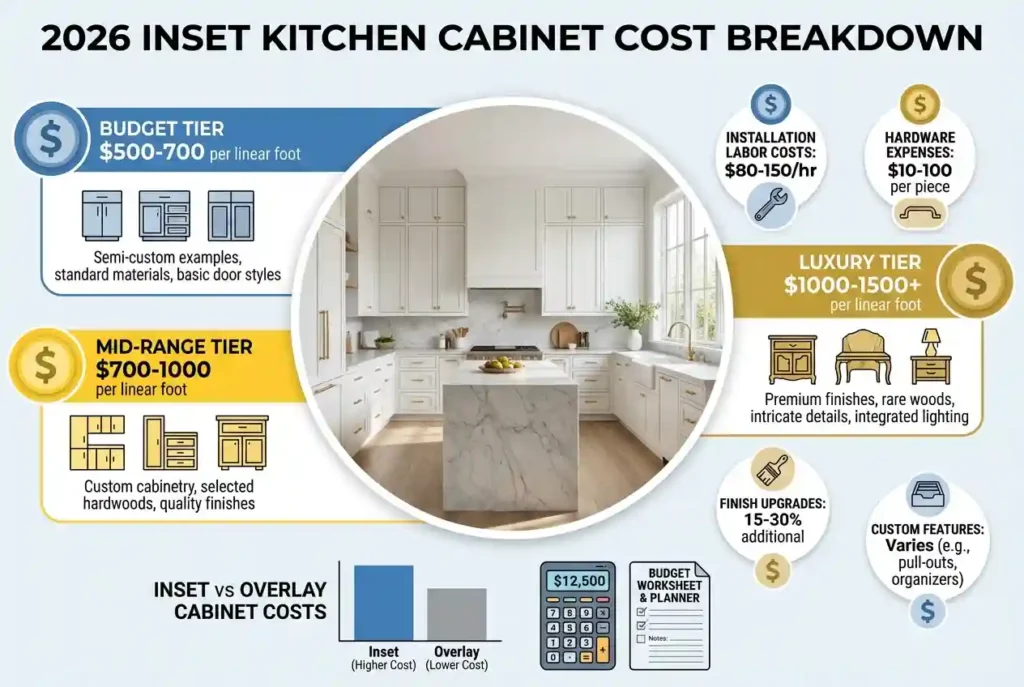
Let’s get real about money. Inset cabinets are undeniably beautiful, but they’re also a premium product, and understanding the full cost picture upfront will save you from sticker shock halfway through your remodel. Here’s what US homeowners should expect to budget in 2026.
Price Per Linear Foot Breakdown
Cabinet pricing in the US is most commonly quoted per linear foot, which measures the total length of cabinetry along your walls. For inset cabinets, the range is wide because quality, materials, and customization levels vary dramatically.
Here’s a realistic breakdown for 2026:
| Cabinet Tier | Price Per Linear Foot | 35–45% Premium vs. Overlay |
|---|---|---|
| Stock Inset | $150–$350 | Comparable overlay: $100–$250/LF |
| Semi-Custom Inset | $350–$750 | Comparable overlay: $250–$500/LF |
| Fully Custom Inset | $750–$1,200+ | Comparable overlay: $500–$800/LF |
For a typical US kitchen with 25 linear feet of cabinetry, that translates to:
- Stock inset: $3,750–$8,750
- Semi-custom inset: $8,750–$18,750
- Fully custom inset: $18,750–$30,000+
Key takeaway: The 35–45% premium over overlay cabinets is consistent across every tier. Whether you’re buying stock or fully custom, you’re paying more for the precision engineering that defines inset construction.
Keep in mind that these figures cover cabinetry only, not countertops, hardware, installation, or lighting. We’ll cover installation costs in a moment.
Stock vs. Semi-Custom vs. Fully Custom Inset Cabinets
Not all inset cabinets are created equal, and understanding the three main tiers will help you match your expectations to your budget.
Stock Inset Cabinets ($150–$350/Linear Foot)
Stock cabinets are pre-manufactured in standard sizes (typically in 3″ width increments: 9″, 12″, 15″, 18″, etc.) and ship quickly — usually within 1–3 weeks. The trade-off is limited customization. You’ll choose from a set list of door styles, finishes, and dimensions. Stock inset options have become more widely available in recent years through online RTA (Ready-to-Assemble) retailers, making this the most accessible entry point into the inset world.
Best for: Budget-conscious homeowners who love the inset look and have a kitchen layout that works well with standard cabinet sizes.
Semi-Custom Inset Cabinets ($350–$750/Linear Foot)
This is the sweet spot for most US homeowners. Semi-custom cabinets start with a standard base size but allow meaningful modifications, adjusted widths, custom depths, specialty storage inserts, a wider range of door profiles, wood species, and paint or stain finishes. Lead times typically run 6–10 weeks.
Best for: Homeowners who want a tailored look and functional upgrades without the price tag of a fully bespoke kitchen.
Fully Custom Inset Cabinets ($750–$1,200+/Linear Foot)
This is the top of the line. Every single cabinet is built from scratch to your exact specifications — any dimension, any wood species, any finish, any interior configuration. Expect lead times of 10–16 weeks or more, and expect to work closely with a designer or cabinetmaker throughout the process.
Best for: High-end remodels, historic homes with non-standard dimensions, homeowners who want absolute control over every detail, and kitchens where the cabinetry is the showpiece.
| Feature | Stock | Semi-Custom | Fully Custom |
|---|---|---|---|
| Size Options | Standard increments only | Modified standard sizes | Any dimension |
| Door Styles | Limited selection | Broad selection | Unlimited |
| Finish Options | 10–20 choices | 30–60+ choices | Unlimited |
| Lead Time | 1–3 weeks | 6–10 weeks | 10–16+ weeks |
| Interior Accessories | Basic | Wide range of add-ons | Fully bespoke |
| Best Budget Fit | $4K–$9K (25 LF) | $9K–$19K (25 LF) | $19K–$30K+ (25 LF) |
Installation Costs and What to Expect
Even the finest inset cabinets will look terrible if they’re installed poorly, and with inset construction, there’s absolutely no room for error. That 3/32″ reveal gap tells the whole story. If the installation is even slightly off, every door and drawer will announce it.
Professional installation for inset cabinets typically runs $100–$150 per cabinet. For an average US kitchen with 20–30 individual cabinets, that puts your installation budget at roughly $2,000–$4,500.
Here’s what a professional installer will handle that most DIYers can’t:
Precision Leveling and Shimming US kitchens rarely have perfectly level floors or plumb walls. A skilled installer uses shims, scribes, and laser levels to ensure every cabinet sits perfectly true, because inset doors will bind, stick, or gap unevenly on a cabinet that’s even 1/16″ out of level.
Hinge Calibration Inset cabinet hinges require three-dimensional adjustment (up/down, left/right, in/out) to achieve that perfect reveal gap on all four sides of every door. This process alone can take hours across a full kitchen.
Filler Strips and Scribe Molding. Where cabinets meet walls, corners, or appliances, the installer will use custom-cut filler strips to maintain the clean inset aesthetic. This detailed work is what separates a professional result from an amateur one.
Why DIY is not recommended: I know it’s tempting to save a few thousand dollars, but inset cabinet installation is genuinely one of the most unforgiving tasks in kitchen remodeling. Misaligned doors are visible from across the room, and correcting mistakes after the fact often means removing and rehanging entire doors. Invest in professional installation, your cabinets (and your sanity) will thank you.
How to Get the Inset Look on a Tighter Budget
Love the inset aesthetic but not the inset price tag? You’re not alone, and fortunately, there are several smart strategies to achieve a similar look without blowing your budget.
1. The Filler Strip Technique. Some cabinet builders offer a modified overlay cabinet with applied filler strips on the face frame that mimic the look of an inset reveal. From a normal viewing distance, the effect is surprisingly convincing. Cost savings: 20–30% compared to true inset.
2. Faux Inset (Applied Molding) Doors. Faux inset doors are standard overlay doors with an added molding or bead applied to the face frame, creating the visual illusion of an inset cabinet. Several major US manufacturers now offer this as a catalog option. You get the shadow lines and visual depth of an inset at overlay pricing.
3. Cabinet Refacing with Inset-Style Doors If your existing cabinet boxes are structurally sound, refacing, replacing just the doors, drawer fronts, and face frame veneer, is one of the most cost-effective ways to achieve an inset look. Refacing typically costs $5,000–$15,000 for a full kitchen, compared to $20,000–$40,000+ for new custom inset cabinets.
4. Mix Inset with Overlay Strategically. Here’s a designer secret I use with clients all the time: use true inset cabinets only where they’ll have the most visual impact, the island, a display hutch, or a focal wall, and use high-quality full overlay cabinets everywhere else. This approach can cut your total cabinet budget by 25–35% while still delivering that luxury inset statement where it matters most.
Key takeaway: You don’t have to go all-inset to get the look. A smart mix of true inset, faux inset, and strategic placement can deliver stunning results at a fraction of the full custom price.
Best Design Styles for Inset Kitchen Cabinets
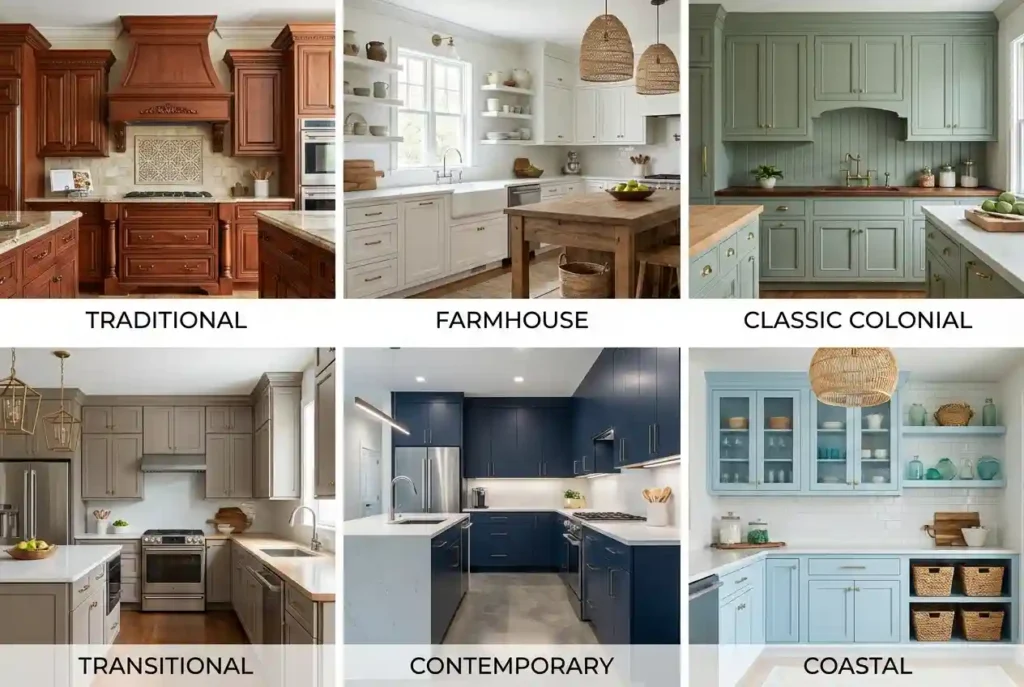
One of the things I love most about inset cabinetry is its incredible design versatility. While many people associate inset cabinets with traditional kitchens, the truth is they look absolutely stunning across a wide range of styles. The key is pairing the right door profile, frame type, and hardware finish with your home’s overall aesthetic.
Let’s explore five popular design styles where inset cabinets truly shine.
Traditional & Colonial Kitchens
If there’s one style that inset cabinets were practically born for, it’s the traditional American kitchen. Think stately Colonial homes, Georgian estates, and classic Northeastern brownstones, spaces where rich architectural detail and old-world craftsmanship take center stage.
For traditional kitchens, I recommend a beaded inset frame paired with a raised panel door profile. The bead detail around each door opening adds that extra layer of depth and formality that traditional design demands, while the raised panel echoes the look of fine furniture and millwork found throughout historic American homes.
Hardware finish: Polished nickel or antique brass are your go-to choices here. A classic knob on doors paired with a traditional bail pull on drawers feels perfectly at home in this setting. Look for hardware with subtle decorative detailing — think acorn finials, beaded backplates, or reeded knobs.
Color recommendation: Rich, saturated tones work beautifully. Consider Benjamin Moore White Dove OC-17 for a warm, classic white, or go bold with a deep hunter green or heritage navy. Stained finishes in cherry or mahogany are also a natural fit, emphasizing the wood grain and craftsmanship that define this style.
Pro tip: Crown molding at the top of your wall cabinets and decorative corbels flanking the range hood will amplify the traditional character of your inset cabinetry and tie the whole kitchen together.
Modern Farmhouse
The modern farmhouse trend shows no signs of slowing down in the US, and inset cabinets are a perfect match for this style’s blend of rustic warmth and clean simplicity. Where a traditional farmhouse might lean heavily on open shelving and distressed finishes, the modern farmhouse version embraces a more refined, polished approach — and that’s exactly where inset cabinetry fits in.
For this look, go with a flush inset frame and a Shaker-style door profile. The Shaker door’s flat center panel and clean rail-and-stile construction perfectly capture the farmhouse ethos of honest, unfussy craftsmanship. The flush frame keeps the overall look streamlined and contemporary while still feeling warm and approachable.
Hardware finish: Matte black is the dominant hardware choice in modern farmhouse kitchens, and for good reason — it provides a striking contrast against lighter cabinet colors and echoes the look of wrought iron barn hardware. Simple cup pulls on drawers, and round knobs on doors keep things grounded and unpretentious.
Color recommendation: Sherwin-Williams Alabaster SW 7008 is a modern farmhouse staple — it’s a soft, creamy white that feels inviting without being stark. For a two-tone approach, pair white perimeter cabinets with a stained wood island in white oak or hickory for that signature farmhouse warmth.
Pro tip: Add open shelving in matching white oak or reclaimed wood between your inset wall cabinets. This breaks up the cabinetry visually and gives you a spot to display stoneware, cutting boards, and cookbooks — all those curated farmhouse details that make the style feel lived-in and personal.
Transitional & Shaker-Style Kitchens
Transitional design is the sweet spot between traditional and contemporary — and it’s one of the most requested kitchen styles in the US right now. It borrows the warmth and detail of classic design while embracing the clean lines and uncluttered feel of modern spaces. Inset cabinets are a natural fit because they straddle that same line beautifully.
The ideal pairing here is a flush inset frame with a Shaker or recessed flat-panel door. The simplicity of the Shaker profile provides clean geometry without feeling cold, and the flush frame reinforces that sense of quiet precision. No ornate details are competing for attention — just thoughtful, balanced design.
Hardware finish: Brushed nickel or satin brass strikes the perfect transitional note. These finishes feel polished but not overly formal. For a cohesive look, opt for simple bar pulls in 5″–8″ lengths on drawers and round or square knobs on doors. Keep the lines straight and the profiles minimal.
Color recommendation: Neutral tones dominate transitional kitchens. Benjamin Moore Chantilly Lace OC-65 delivers a bright, true white that works beautifully under both natural and artificial light. For something warmer, Sherwin-Williams Accessible Beige SW 7036 or a light warm gray like BM Revere Pewter HC-172 gives the space an effortless sophistication.
Pro tip: In transitional kitchens, let the cabinetry do the talking. Keep countertops clean (a simple white quartz or marble-look surface), minimize upper cabinet clutter, and invest in under-cabinet LED lighting to highlight those crisp inset shadow lines. Less is more in this style.
Contemporary & European-Inspired Kitchens
You might not immediately associate inset cabinets with contemporary design — but here’s the thing: the flush, precise geometry of inset construction is inherently modern. When you strip away the beaded frames and traditional hardware, what you’re left with is a grid of perfectly aligned, flush-mounted panels. That’s about as contemporary as it gets.
For this style, choose a flush inset frame with a slab (flat-panel) door — no rails, no stiles, no raised panels. Just a smooth, uninterrupted surface that emphasizes material and form over ornamentation. This is where inset cabinetry meets European sensibility.
Hardware finish: Integrated edge pulls, finger pulls, or push-to-open (touch-latch) mechanisms are the top choice for contemporary inset kitchens. If you prefer visible hardware, go with slim bar pulls in matte black or brushed stainless steel, mounted horizontally on drawers and vertically on doors for a clean, linear effect.
Color recommendation: Bold, saturated colors make a statement here. Benjamin Moore Hale Navy HC-154 or a deep charcoal like BM Wrought Iron 2124-10 create a dramatic, gallery-like feel. For a warmer contemporary look, consider a matte sage green or warm putty tone. High-gloss or matte lacquer finishes — rather than traditional paint — elevate the modern aesthetic even further.
Pro tip: Pair slab-door inset cabinets with a handleless design on the upper wall cabinets and visible hardware only on the base cabinets. This creates a visual hierarchy that draws the eye downward and makes the kitchen feel taller and more open. It’s a technique borrowed from high-end European kitchen brands that translates beautifully to US homes.
Craftsman & Period Homes
If you’re lucky enough to own a Craftsman bungalow, Arts & Crafts home, Tudor revival, or any pre-war period property, inset cabinets aren’t just a design choice — they’re a restoration of authenticity. These homes were originally built with inset cabinetry, and replacing modern overlay cabinets with true inset construction can bring your kitchen back in line with your home’s architectural DNA.
The recommended pairing here is a beaded inset frame with a mission-style or flat-panel door featuring visible mortise-and-tenon joinery details. Quarter-sawn white oak is the quintessential Craftsman wood species, prized for its distinctive ray-flake grain pattern and exceptional durability.
Hardware finish: Oil-rubbed bronze or aged copper honors the Craftsman emphasis on natural, hand-worked materials. Look for simple square knobs and mission-style bin pulls — hardware that feels handcrafted rather than mass-produced. Avoid anything too shiny or ornate; Craftsman design is rooted in honesty and simplicity.
Color recommendation: Let the wood be the star. A natural or honey-toned stain on quarter-sawn white oak is the most authentic choice and showcases the craftsmanship of the inset construction beautifully. If you prefer paint, opt for deep, earthy tones — BM Tate Olive HC-112 or a rich forest green — that complement the warm wood tones found throughout most period homes.
Pro tip: In Craftsman and period kitchens, details matter more than anywhere else. Consider adding art glass inserts to a few upper cabinet doors, and use furniture-style legs or exposed feet on your base cabinets to reinforce the built-in furniture aesthetic. Every choice should feel like it could have been original to the home — that’s how you honor the architecture while creating a kitchen that works for modern life.
Choosing the Right Color for Inset Cabinets
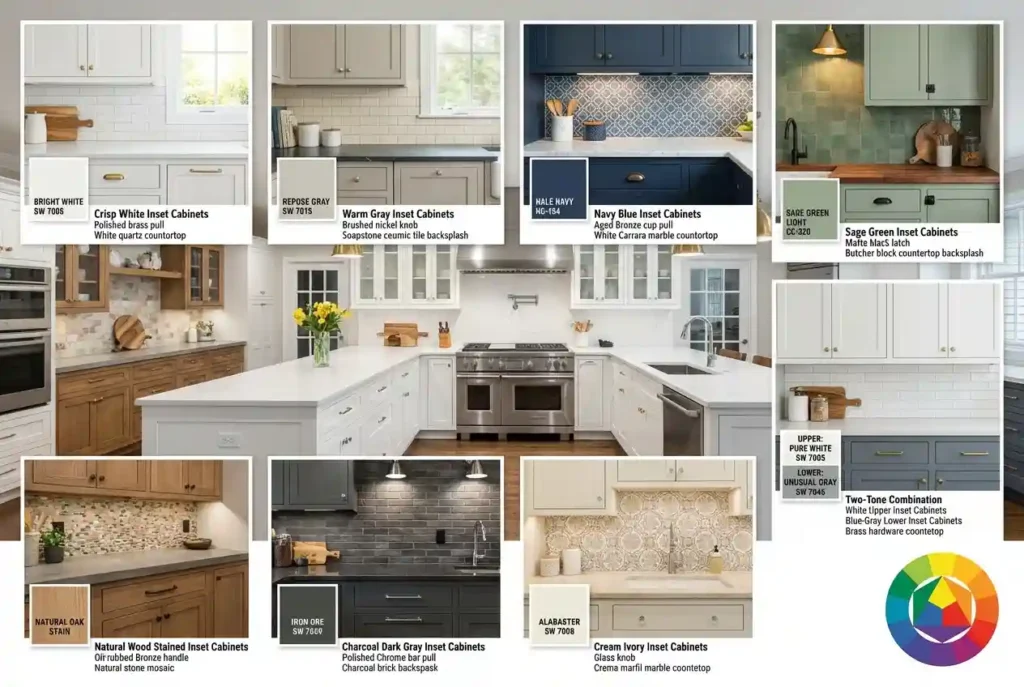
Color is where your inset cabinets truly become yours. The flush, precise lines of inset construction create a beautiful canvas that highlights paint color and finish quality unlike any other cabinet style. Because every door sits perfectly within its frame, color consistency and sheen uniformity are on full display, which means your color choice matters more here than it does with overlay or frameless cabinets.
Let’s walk through the colors, combinations, and finishes that are making the biggest impact in US kitchens right now.
Best White Paint Colors for Inset Cabinets
White remains the most popular cabinet color in US kitchens — and for good reason. It’s timeless, versatile, and photographs beautifully (hello, resale value). But not all whites are created equal, and the wrong shade can look sterile, dingy, or completely off in your space. Here are four tried-and-true whites that consistently look stunning on inset cabinetry:
Benjamin Moore Chantilly Lace OC-65. This is as close to a true, clean white as you’ll find. It has virtually no visible undertone, which makes it incredibly versatile under all lighting conditions. If you want your kitchen to feel bright, crisp, and modern, Chantilly Lace is the safe bet. It’s particularly striking on flush inset Shaker doors in contemporary and transitional kitchens.
Benjamin Moore White Dove OC-17 A designer favorite for decades, White Dove is a soft, warm white with a subtle yellow-gray undertone. It reads as white on the cabinets but feels gentler and more approachable than a pure white. This is my go-to recommendation for traditional kitchens, farmhouse spaces, and any kitchen with warm-toned countertops, flooring, or backsplash materials.
Sherwin-Williams Snowbound SW 7004 Snowbound sits in that sweet spot between crisp and warm — a clean white with the faintest greige undertone. It plays beautifully with both cool and warm elements in a kitchen, making it one of the most adaptable whites on the market. It’s an excellent choice if you’re pairing white inset cabinets with a gray or marble-look quartz countertopSherwin-Williamsms Alabaster SW 7008 Alabaster is the warmest white on this list, with a noticeable creamy, slightly yellow undertone. It’s the signature color of modern farmhouse design and looks incredibly inviting on beaded inset cabinets. If your kitchen gets limited natural light, Alabaster can add warmth without making the space feel dark.
Key takeaway: Always test your white in your actual kitchen before committing. Paint a large sample board (at least 12″ x 12″) and observe it at different times of day, under both natural and artificial light. Whites shift dramatically depending on your lighting, and what looks perfect in the store can read completely differently on your cabinets at home.
Trending Colors: Navy, Sage, and Warm Neutrals
While white continues to dominate, bold and nature-inspired cabinet colors have been gaining serious momentum across the US. Inset cabinets are an especially strong candidate for color because the shadow lines of the reveal gap add depth and dimension that make saturated hues look even richer.
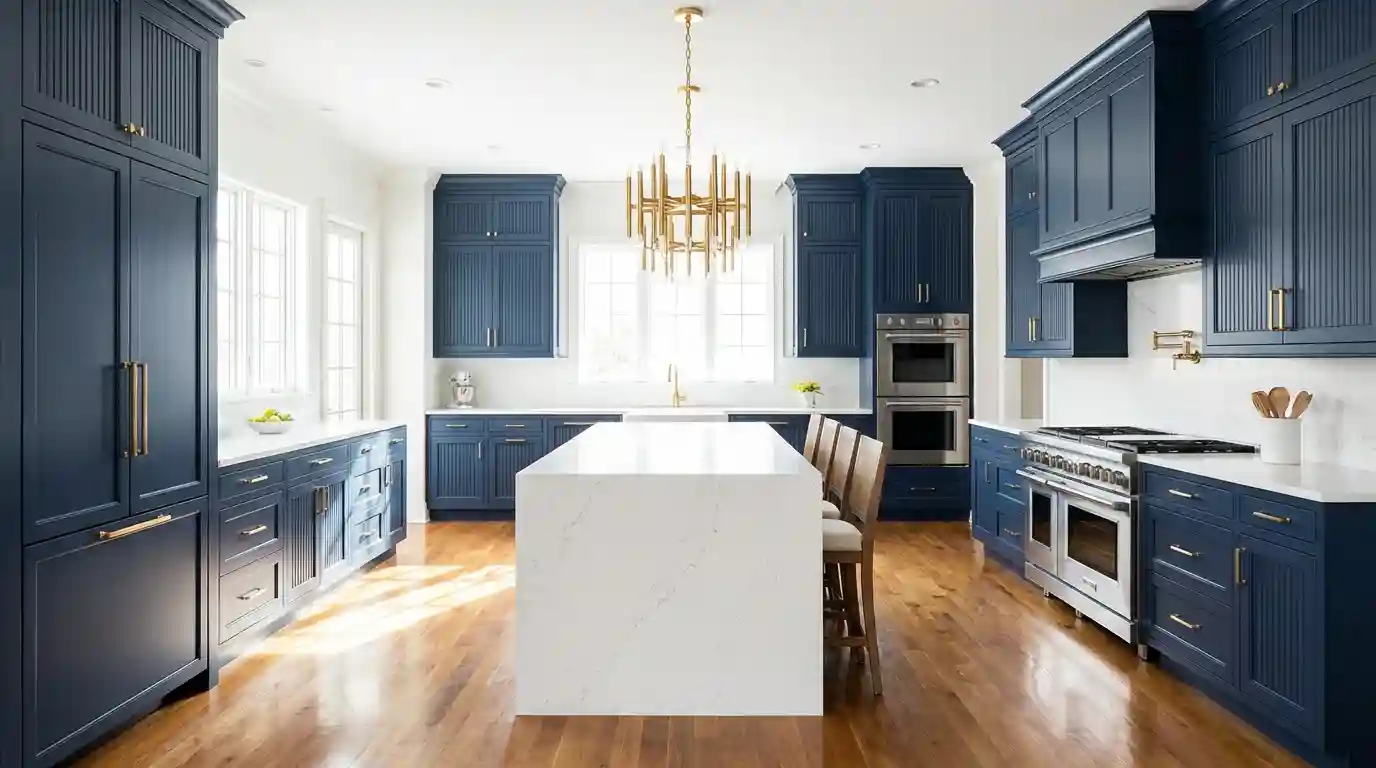
Benjamin Moore Hale Navy HC-154 Hale Navy is the undisputed champion of blue kitchen cabinets in the US. It’s a deep, classic navy with just enough gray to keep it from feeling too preppy or nautical. On inset cabinets, it looks spectacular — the shadow lines of the reveal gap create a subtle interplay of dark tones that gives the cabinetry incredible visual depth. Pair it with brass hardware and white marble countertops for a combination that feels luxurious and timeless.
Sherwin-Williams Evergreen Fog SW 9130. This muted, sophisticated sage green has exploded in popularity and shows no signs of fading. It’s earthy without being heavy, calming without being cold, and pairs effortlessly with both warm wood tones and cool stone surfaces. On inset cabinets, Evergreen Fog creates a soft, organic feel that’s perfect for transitional and modern farmhouse kitchens. Try it with brushed nickel or aged brass hardware and a butcher block or light quartz countertop.
Benjamin Moore Baby Fawn OC-1.5. For homeowners who want to step away from white but aren’t ready for a bold color, Baby Fawn is a beautiful middle ground. It’s a warm, creamy neutral with a soft tan undertone — think of it as a sophisticated beige that reads as intentional rather than builder-grade. On inset cabinets, this color feels warm, grounded, and quietly elegant. It’s especially effective in kitchens with natural stone, terracotta tile, or warm wood flooring.
Other colors worth considering for 2026: forest green (BM Essex Green HC-188), warm black (BM Onyx 2133-10), dusty rose (SW Rosy Outlook SW 6316), and rich terracotta tones that nod to the ongoing organic-modern trend in US interiors.
Two-Tone Inset Cabinet Combinations
Two-tone kitchens have moved well beyond trend status — they’re now a firmly established design strategy that adds visual interest, defines zones, and allows you to incorporate color without overwhelming the space. And because inset cabinets already have a strong visual structure thanks to those reveal lines, they handle two-tone combinations with particular elegance.
Here are three combinations I recommend to clients again and again:
Light Uppers, Dark Island. This is the most popular two-tone approach in the US, and it works beautifully with inset cabinetry. Keep your perimeter wall and base cabinets in white or a soft neutral (like White Dove or Snowbound), and make the island the star with a bold color — Hale Navy, a deep charcoal, or a rich hunter green. The island becomes a grounding anchor in the kitchen while the perimeter stays bright and airy.
White Perimeters with a Stained Wood Island. If you want warmth and texture rather than bold color, a natural stained wood island paired with painted white perimeter cabinets is a stunning choice. White oak is the most popular wood species for this look right now, with a clear or light honey stain that showcases the grain. The contrast between the painted precision of the white inset cabinets and the organic, tactile beauty of the wood island creates a kitchen that feels both refined and inviting.
Upper and Lower Color Split A bolder approach: paint your upper wall cabinets a lighter shade and your lower base cabinets a deeper tone. For example, Alabaster uppers with Evergreen Fog bases, or Chantilly Lace uppers with Baby Fawn bases. This technique draws the eye downward, grounds the space, and makes the kitchen feel taller. It works best in kitchens with at least 8’–9′ ceiling heights so the color split doesn’t feel cramped.
Key takeaway: When going two-tone with inset cabinets, keep the frame profile and door style consistent across both colors. Mixing door styles and colors creates visual chaos. Let the color do the differentiating while the consistent inset construction ties everything together.
Stained vs. Painted Finishes: Pros and Cons for Inset Doors
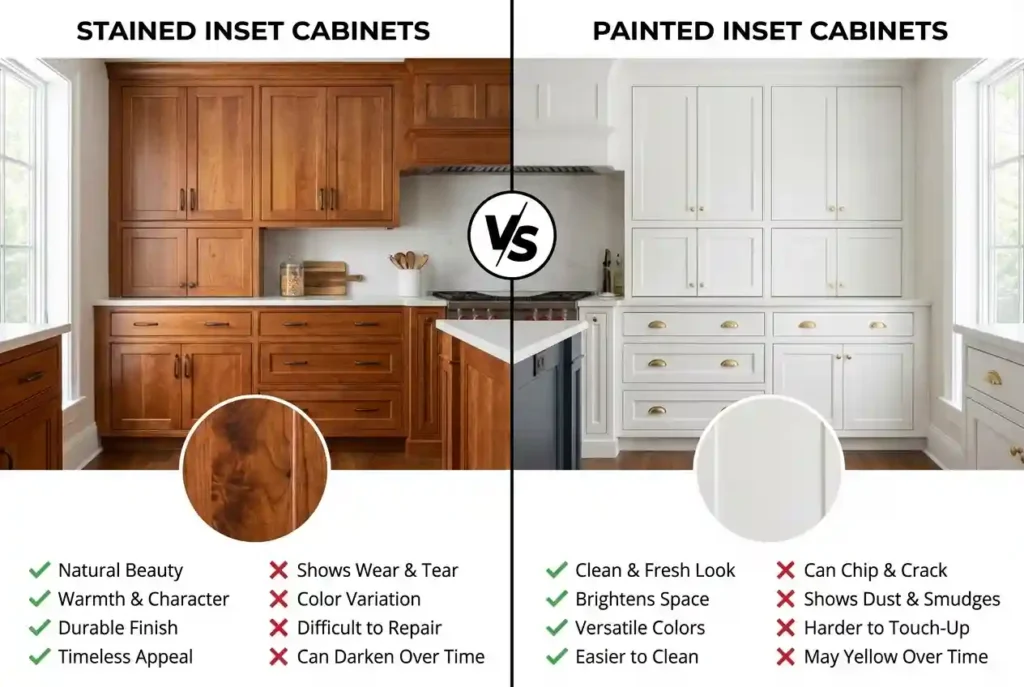
This is one of the most important finish decisions you’ll make, and inset cabinets raise the stakes because both the doors and the face frame must match perfectly. Here’s how the two options compare:
Painted Inset Cabinets
Paint offers the widest range of color options and delivers a smooth, uniform appearance that’s ideal for contemporary, transitional, and farmhouse kitchens. A high-quality cabinet paint, like Benjamin Moore Advance or Sherwin-Williams Emerald Urethane Trim Enamel, provides a durable, washable finish with a beautiful semi-smooth sheen.
However, painted inset cabinets have one notable vulnerability: hairline cracks at the joints. Because the doors sit inside the frame, the wood-to-wood contact points are highly visible, and seasonal expansion and contraction can cause tiny cracks in the paint film where the door meets the frame. This is normal; it’s not a defect, but it’s more noticeable on painted surfaces than stained ones.
Stained Inset Cabinets
Stain highlights the natural beauty of the wood grain and creates a warm, organic feel. It’s the traditional choice for Craftsman kitchens, period homes, and any space where you want the material itself to be the star. Popular wood species for stained inset cabinets include white oak, cherry, maple, and hickory.
The advantage of stain over paint on inset doors is that small imperfections are far less visible. Hairline joint cracks, minor dings, and the natural character of wood movement blend into the grain rather than standing out. The trade-off is a more limited color palette — you’re working within the range of the wood’s natural tones.
| Factor | Painted | Stained |
|---|---|---|
| Color Options | Unlimited | Limited to wood species tones |
| Appearance | Smooth, uniform, modern | Natural grain, warm, organic |
| Joint Visibility | Hairline cracks may show over time | Cracks are less noticeable |
| Touch-Up Ease | More difficult to color-match | Easier to blend touch-ups |
| Best Style Fit | Transitional, farmhouse, contemporary | Craftsman, traditional, rustic |
| Maintenance | Wipe clean easily; may need repainting in 8–12 years | Periodic re-sealing; patinas naturally |
Key takeaway: Neither option is objectively better; the right choice depends entirely on your design style, lifestyle, and tolerance for natural wood behavior. If you want a crisp, colorful kitchen, go painted. If you want warmth and character that deepens with age, go stained.
Hardware trends in 2026 are moving in an exciting direction, away from mass-produced uniformity and toward warmth, texture, craftsmanship, and living finishes that develop character over time. Here’s what’s leading the way and how each trend pairs with inset cabinetry:
Aged and Unlacquered Brass Brass isn’t going anywhere; in fact, it’s only gaining momentum. The biggest shift for 2026 is toward aged, unlacquered brass that develops a natural patina with daily use. Unlike lacquered finishes that maintain a fixed appearance, unlacquered brass darkens and evolves, creating a warm, lived-in quality that pairs beautifully with the handcrafted character of inset cabinets. Designers are calling it a living finish, hardware that gets more beautiful, not worn.
Best pairing: Beaded inset frames in traditional, farmhouse, and transitional kitchens. The patina of aged brass echoes the old-world craftsmanship that inset construction represents.
Bronze. The Breakout Metal of 2026 Bronze is emerging as the standout hardware metal this year, particularly in deeper, burnished variations. It carries warmth like brass but with a richer, darker depth that bridges classic and contemporary cabinetry. Naturally oxidized bronze and dark bronze finishes that develop unique patinas over time are especially sought after.
Best pairing: Craftsman kitchens with stained white oak inset cabinets, or transitional kitchens where you want a warm metallic accent that feels substantial and grounded.
Matte Black, Still Relevant, but Evolving. While some trend reports suggest matte black is losing its dominant position, it remains a strong, versatile choice — especially in modern farmhouse and contemporary kitchens. The shift is toward more nuanced black finishes: think hand-forged flat black, softly brushed black, or black with subtle bronze undertones rather than a flat, uniform factory matte. On flush inset slab doors, a slim matte black bar pull still makes a clean, architectural statement.
Best pairing: Modern farmhouse with white or light-colored Shaker inset cabinets, and contemporary kitchens with slab-front inset doors.
Brushed and Satinated Nickel Cool-toned metals haven’t disappeared — they’ve simply softened. For 2026, brushed nickel and satin nickel are favored over high-polish chrome. These finishes offer a matte, tactile surface that feels less reflective and more organic than their shinier counterparts. They’re exceptionally versatile and work in virtually every kitchen style.
Best pairing: Transitional and Shaker-style inset kitchens. Satin nickel complements both warm and cool color palettes without competing for attention.
Mixed Metals — Done Intentionally.y The era of matching every metal in the kitchen is officially over. In 2026, intentionally mixed metals are a sign of a well-curated, collected-over-time kitchen. Thekeywordd is intentional. A popular approach is pairing aged brass cabinet hardware with a brushed nickel faucet, or bronze pulls on the island with matte black on the perimeter cabinets.
The rule of thumb: choose a dominant metal (used on 70% of the hardware) and an accent metal (used on 30%), and repeat the accent metal in at least one other element — a light fixture, a pot filler, or a range hood strap — to create visual cohesion.
Textured and Artisan-Crafted Pieces. One of the most distinctive trends for 2026 is a move toward hardware that shows the hand of the maker. Knurled knobs, hammered pulls, reeded bar handles, and etched detailing are replacing smooth, featureless surfaces. These tactile elements add a subtle layer of craftsmanship that aligns perfectly with the precision and artistry of inset cabinet construction. Designers are also reviving decorative backplates — the ornamental plates that sit behind a knob or pull — as a way to introduce character without replacing existing hardware.
Best pairing: Traditional and Craftsman inset kitchens where visible craftsmanship is part of the design story, and transitional kitchens where a single textured accent piece adds a curated, collected feel.
Key takeaway: The overarching theme for 2026 hardware is authenticity. Homeowners are choosing finishes that age gracefully, textures that invite touch, and metals that feel warm and personal. On inset cabinets, where every detail is on full display, this shift toward craftsmanship and character couldn’t be a better match.