Dining Room Decor Modern Classy. $1,500 Budget Guide (2026)
I spent $800 on my first attempt at modern classy dining room decor and ended up with a space that looked like a West Elm showroom collided with my grandma’s china cabinet. After two more tries and countless Facebook Marketplace deep dives, I finally cracked the code. Here’s exactly what works, what bombs, and how to pull it off without dropping $5,000.
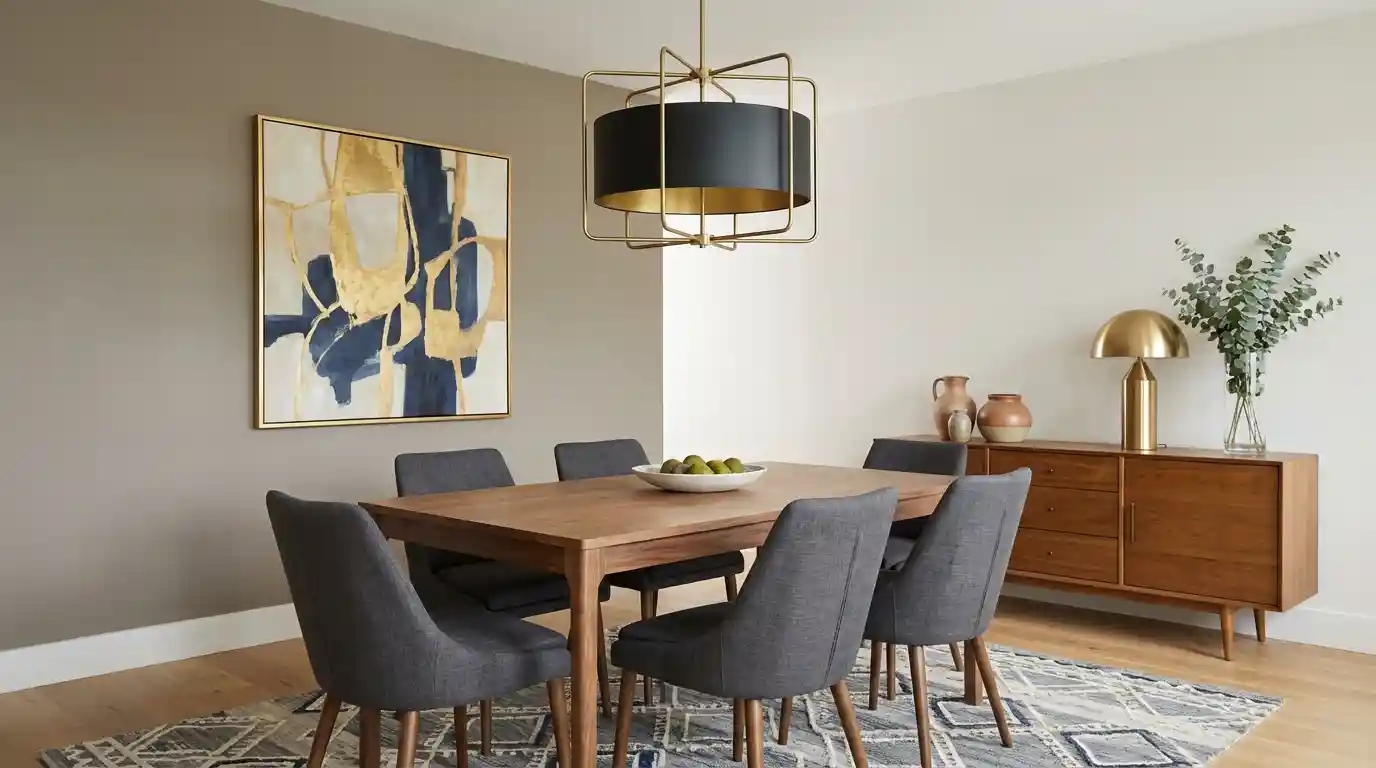
Quick Answer. Modern classy dining room decor balances clean-lined furniture (simple tables, streamlined chairs) with elevated touches like a statement chandelier, rich textures, and strategic vintage pieces. Total budget: $1,200-$1,800. The secret: splurge on lighting, save on furniture with smart shopping and IKEA hacks.
What “Modern Classy” Actually Means (And Why It’s So Tricky)
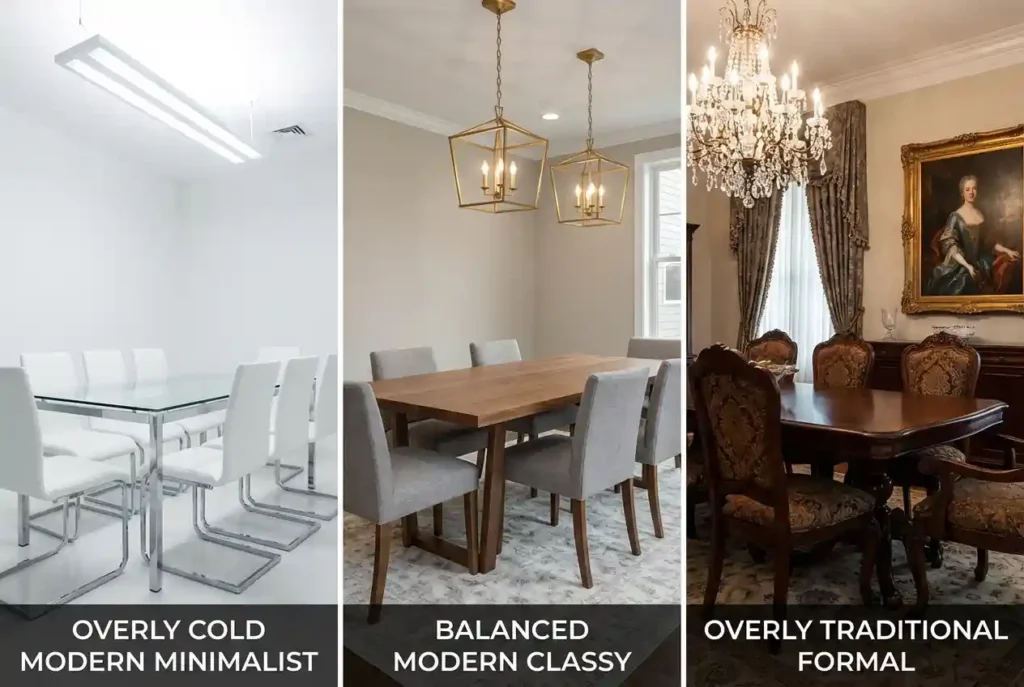
Here’s the thing. Modern and classy are kind of fighting each other.
Modern means clean lines, minimal fuss, and functional design. It’s that sleek IKEA vibe with nothing extra. But go too modern, and you get a cold showroom that feels like you’re eating dinner in an Apple Store.
Classy means refined, elegant, and timeless. Think linen napkins and a nice sideboard. But lean too hard into classy and suddenly you’re having Sunday dinner at your great-aunt’s house with the plastic-covered chairs.
The sweet spot? That’s where modern simplicity meets classy warmth without either one winning.
I learned this the hard way in 2022. I bought all matching furniture from one store (trying to be “cohesive”), picked the trendiest brass everything, and wondered why my dining room felt like I’d staged it for a real estate listing. My husband walked in and said, “Are we allowed to actually eat in here?”
My Modern Classy Dining Room Budget Breakdown
Okay, real talk—here’s every single dollar I spent.
I’m showing you this because every other “modern dining room” article acts like money grows on trees. They’ll show you a $2,000 table and call it “affordable.” Not here.
| Item | Store | Price | Maya’s Take |
|---|---|---|---|
| Dining table (EKEDALEN extendable) | IKEA | $349 | Swapped the legs for $40 tapered ones from Amazon—total game changer |
| 4 Dining chairs | Target (Threshold Windsor) | $280 ($70 each) | Looks like $200 chairs. Seriously. |
| Chandelier (sculptural brass) | West Elm (sale section) | $380 | My ONE big splurge. Worth every penny. |
| 8×10 washable rug | Ruggable | $249 | Kids + spaghetti = this was non-negotiable |
| Sideboard (vintage wood) | Facebook Marketplace | $75 | Solid wood. Just needed sanding and paint. |
| Framed art (3 pieces) | HomeGoods + Etsy | $120 | Mixed abstract prints |
| Accent pillows + table decor | Target + TJ Maxx | $61 | Linen napkins, ceramic bowl, candles |
| TOTAL | $1,514 |
What surprised me most? How little I spent on the actual table and chairs compared to the lighting.
I remember standing in West Elm staring at that chandelier thinking, “My husband’s going to kill me.” But when I hung it up, even he admitted it made the whole room look intentional instead of “we just moved in six months ago.”
The “One Nice Thing” Strategy (What Actually Matters)
Listen, if you’re working with a tight budget, you cannot spread $1,500 across ten mediocre purchases and expect magic.
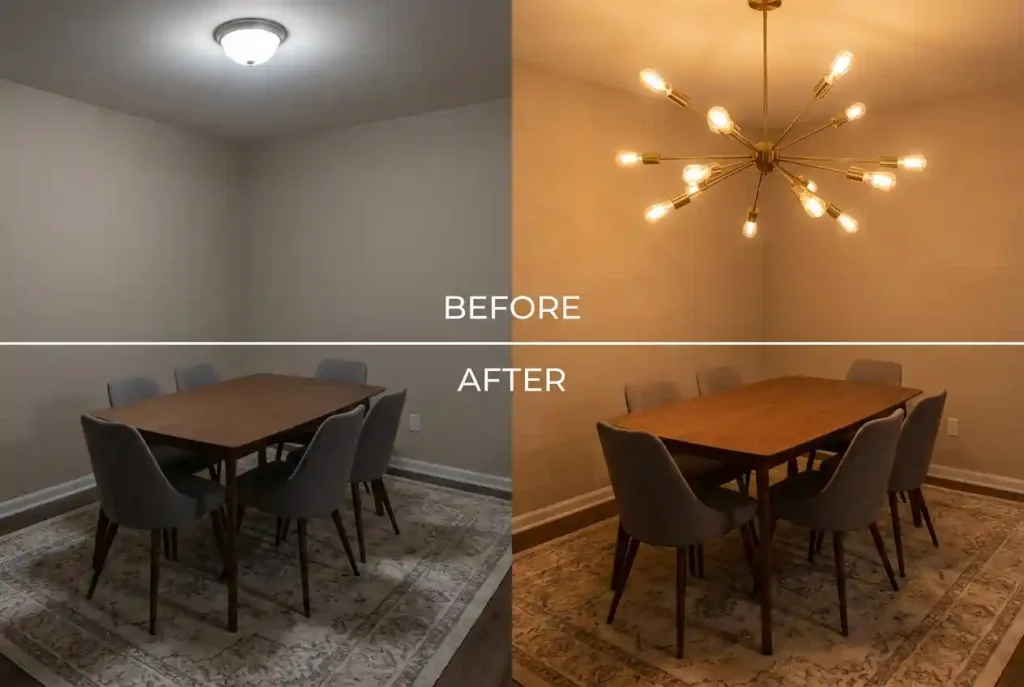
You need one really beautiful thing that makes everything else look better by association. For dining rooms, that’s almost always the lighting.
Here’s why: a gorgeous chandelier hangs at eye level when you’re standing and frames the entire table when you’re sitting. It’s literally the focal point, whether you plan it or not. A $380 light fixture makes $70 Target chairs look curated. A $50 light fixture makes $300 chairs look cheap.
I learned this after my neighbor, Sarah, came over and asked where I got “those beautiful chairs.” They were from Target. She’d walked right past them in the store a hundred times, but under that brass chandelier, they looked like something from Pottery Barn.
Don’t make the same mistake I did on my first try.
If your budget is around $1,500, spend $350-400 on lighting and get scrappy everywhere else. If you’ve got $2,500 to play with, splurge on lighting AND the table, then save on chairs with my IKEA hacks below.
My Furniture Picks (Modern + Classy Without the Showroom Vibes)
The Table (Clean But Not Cold)
You want simple lines, but not so minimal that it looks like a lab table.
The IKEA EKEDALEN is my ride-or-die for budget modern tables. It’s got clean lines, extends for guests, and costs $349. The only problem? Those blocky IKEA legs scream “college apartment.”
The fix: swap them for tapered mid-century legs from Amazon ($40 for a set of four). Takes 20 minutes with a drill. Suddenly, your $349 table looks like a $900 West Elm piece.
If you’re shopping secondhand (and you should be), look for solid wood tables with simple shapes—rectangle or oval, nothing ornate. Avoid glass-top tables unless they have a wood or metal base. All-glass reads too modern and shows every fingerprint.
Chairs That Look $200+ But Cost $70
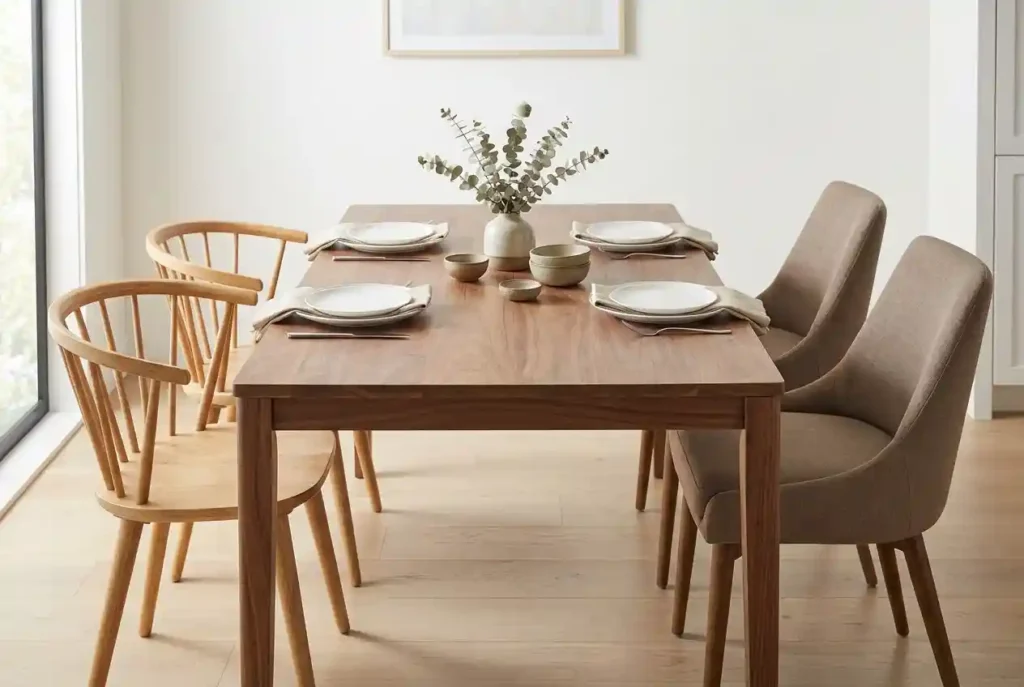
Target’s Threshold Windsor chairs are my secret weapon.
They’re $70 each, come in multiple finishes, and have that spindle-back detail that reads “classy” without being fussy. I have four in my dining room,m and guests always ask where I got them.
The trick: don’t buy all matching chairs unless you want that showroom vibe. Get four of the same style for cohesion, or mix two Windsors with two upholstered ones (IKEA BERGMUND works great for this).
If you go the IKEA route, the TOBIAS ghost chairs are $50 each and invisible, which sounds weird but actually works in small spaces. Add seat cushions in linen or velvet, et and they instantly feel expensive.
The Storage Piece That Ties It Together
Every modern, classy dining room needs one substantial storage piece.
Could be a sideboard, a buffet, or a barcabinete; it doesn’t matter. What matters is that it’s wood, has some visual weight, and gives you a place to style things (lamps, plants, a tray of glasses).
This is where I went full secondhand. I found a 1970s solid oak sideboard on Facebook Marketplace for $75. It was scratched and had ugly brass handles, but the bones were perfect.
I sanded it down, painted it in Benjamin Moore’s Simply White, swapped the hardware for sleek black pulls from Amazon ($18), and now it looks like something from Article. Total investment: $93 and one Saturday.
Lighting: Where Modern Classy Lives or Dies
Chandelier Rules (Height, Size, Style)
Get this wrong, and nothing else matters.
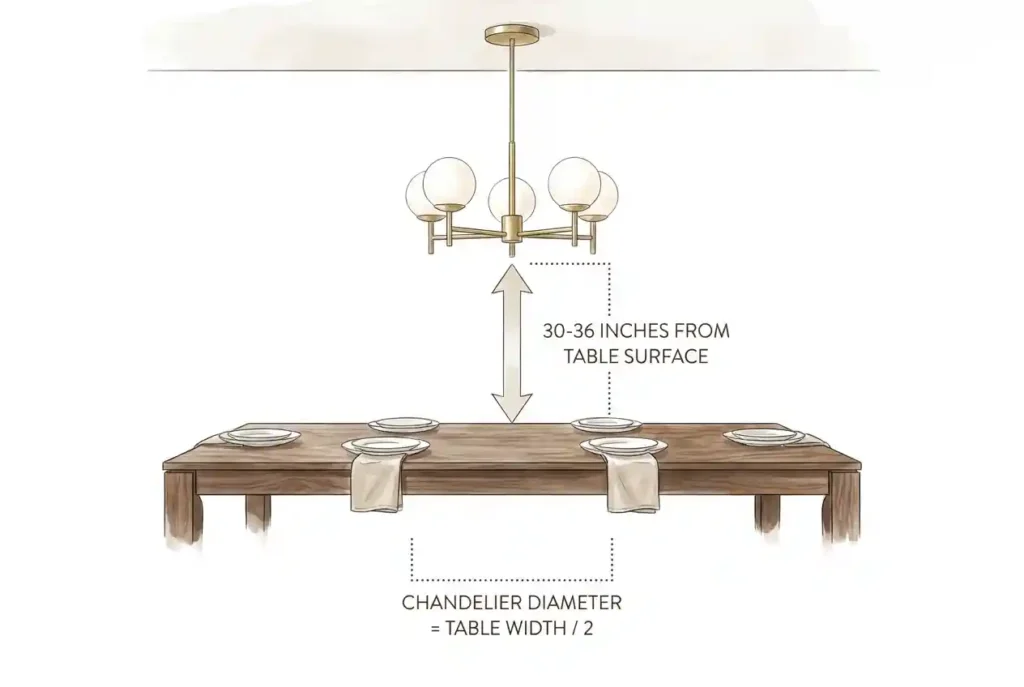
Your chandelier should hang 30-36 inches above the table surface. Not 24 inches (too low, people hit their heads). Not 40 inches (looks like it’s floating away).
For sizing, here’s the formula: your table width minus 12 inches equals your max chandelier diameter. So my 42-inch-wide table needed a chandelier no wider than 30 inches. I went with a 28-inch brass on,e and it’s perfect.
Style-wise, modern classy means mixed materials—brass with glass, matte black with wood, chrome with fabric shades. Avoid full-on crystal chandeliers (too traditional) and spiky sputnik fixtures (too trendy and already dated).
Layering Lighting for That Designer Feel
One overhead light = harsh and flat.
You need at least two light sources, ideally three. I’ve got the chandelier plus two small lamps on the sideboard. When we have people over, I dim the chandelier halfway and turn on the lamps—instant ambiance.
And honestly? Installing a dimmer switch was the single best $15 I spent. I got one at Lowe’s, and my husband installed it in 20 minutes. Now I can go from “help with homework” bright to “dinner party” mood without buying new fixtures.
If you’re on a budget, skip the sconces (they’re expensive to install) and just add a couple of lamps or LED strip lights under the sideboard.
Renter Alternative (No Hardwiring Needed)
Can’t install a hardwired chandelier? Plug-in pendant lights are your answer.
Get a swag hook kit from Home Depot ($8), screw it into the ceiling where you want the light, and hang a plug-in pendant. Run the cord along the ceiling corner to the nearest outlet. You can cover it with cord covers if it bugs you.
I did this in my last apartment with a $120 pendant from IKEA, and it looked completely intentional.
Colors & Materials (The Modern Classy Sweet Spot)
Paint Colors That Actually Work
Stark white walls = too cold. Beige walls = too traditional. You want something in between.
I painted my dining room in Sherwin-Williams Repose Gray, which is a soft greige that reads warm in the evening and clean in the morning. Other winners: Benjamin Moore Balboa Mist, Sherwin-Williams Accessible Beige, or Farrow & Ball Cornforth White if you’ve got the budget.
If you want an accent wall (and you should consider it), go deep: charcoal (SW Iron Ore), moody blue (BM Hale Navy), or earthy green (SW Evergreen Fog). Put it behind the sideboard or the main seating wall.
Avoid: pure white (feels like a doctor’s office), yellow-beige (reads 1990s), and anything too trendy like millennial pink.
The Material Mix Formula
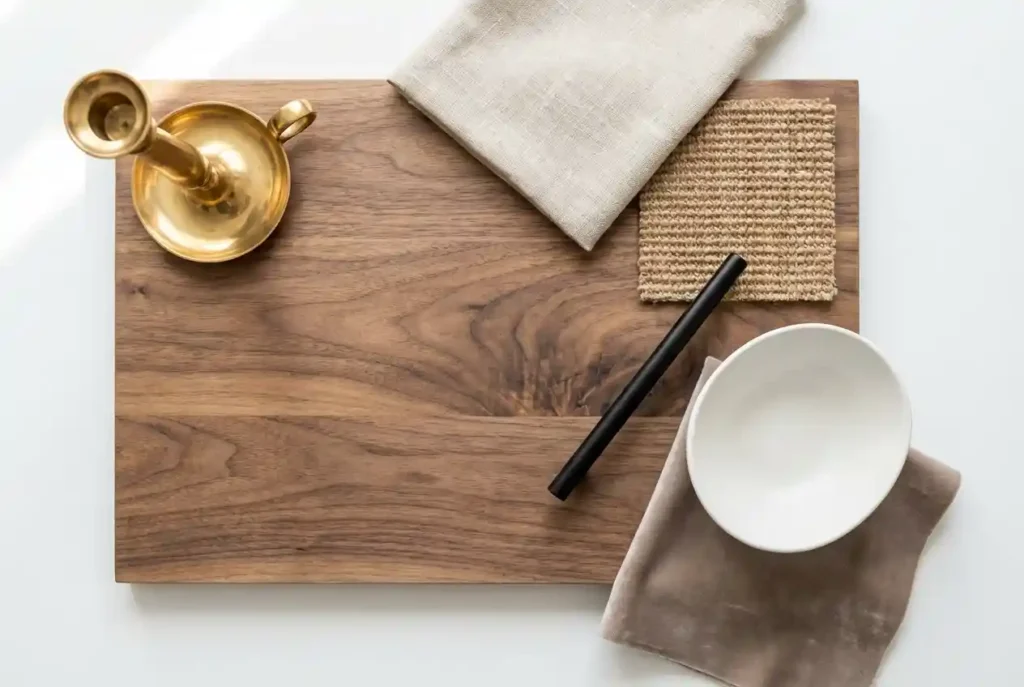
Modern classy needs at least three materials in the room.
Mine: wood table, brass chandelier, linen chair cushions, and a jute rug. That’s actually four, but you get the idea. If everything’s wood, it’s too rustic. If everything’s metal, it’s too industrial.
The ratio I follow: 60% wood/neutral, 30% one metal (brass or black), 10% soft texture (linen, velvet, cotton). This keeps it balanced and prevents that cold modern problem.
Glass and marble work too, but use them sparingly, a glass vase, a marble tray, not an entire glass table.
Adding Warmth Without Losing the Modern Look
This is where most people mess up; they nail the clean lines but end up with a room that feels like a hotel lobby.
The fix? Texture, texture, texture.
Linen napkins in a bowl on the table, not folded in a drawer. A chunky knit throw draped over one chair. Velvet or bouclé cushions on the seats. These little fabric moments make the room feel lived in without adding clutter.
Plants are your other secret weapon. But not the fussy, high-maintenance kind—get a big fiddle leaf fig or a snake plant in a simple ceramic pot. Put it in the corner by the window. Modern spaces need that organic element, or they feel sterile.
For art, go big. One oversized abstract print (24×36 minimum) over the sideboard beats a gallery wall of tiny frames. I got mine from an Etsy seller for $80 and had it printed at Staples for $35.
And here’s something nobody tells you: keep a bowl of lemons or a small wooden tray with candles on the table at all times. It’s the difference between “decorated” and “designed.”
Layout & Flow, Even If Your Room Is Tiny
Standard Rooms (12×14 or Bigger)
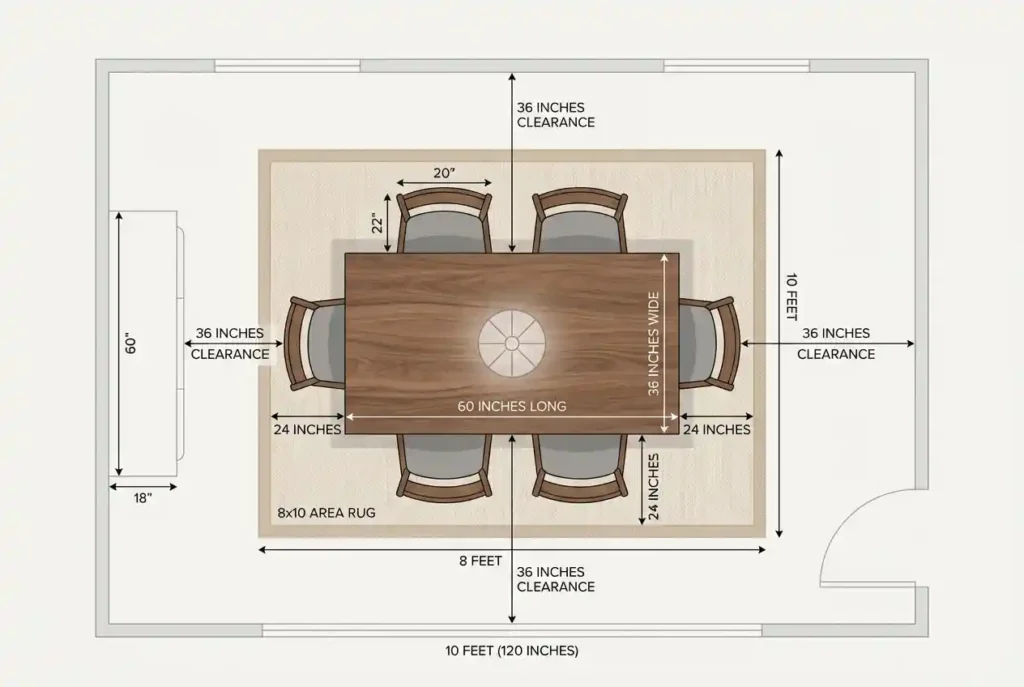
You need 36 inches of clearance around the table for chairs to pull out comfortably.
That means if your table is 42 inches wide, you need a room that’s at least 114 inches (9.5 feet) wide to fit the table plus walkways. I learned this the hard way when my first table was too big, and you had to shimmy sideways to sit down.
Rug sizing matters too: your rug should extend at least 24 inches beyond the table on all sides so chairs stay on the rug when pulled out. For most tables, that’s an 8×10 rug minimum.
Position the table centered under your light fixture if possible. If your room is off-center (like mine), center the table in the usable space and hang the light over the table, not over the room’s center.
Small or Combined Spaces (Under 12×12)
Round tables are your friend in tight spaces—no sharp corners, easier traffic flow.
A 42-inch round can seat four comfortably and takes up less visual space than a rectangular table. Pair it with a bench on one side instead of chairs to save space.
If your dining area shares a room with the living room, use a large rug to visually separate the zones. The dining area gets one rug, the living area gets another. This tricks your eye into seeing two rooms.
My friend Lisa has a 10×11 dining nook and uses two ghost chairs plus a bench. It feels open because the chairs are see-through and the bench tucks completely under the table.
Where to Buy (My Actual Shopping Strategy)
Here’s where I go for every category, sorted by what’s actually worth your money.
| Category | Budget Option | Splurge Option | Maya’s Go-To |
|---|---|---|---|
| Tables | IKEA, Target | West Elm, CB2 | Facebook Marketplace (solid wood) |
| Chairs | Target Threshold, IKEA | Article, Room & Board | Mix: 2 IKEA + 2 secondhand |
| Lighting | Lowe’s, IKEA | Schoolhouse Electric, West Elm | West Elm sale section |
| Rugs | Ruggable, Wayfair | Loloi, Rugs USA | Ruggable (kids + pets) |
| Decor/Art | HomeGoods, Target, TJ Maxx | Etsy prints, Rejuvenation | 80% HomeGoods, 20% Etsy |
| Sideboards | IKEA BESTÅ hack | Crate & Barrel | Facebook Marketplace, refinished |
Pro tip for secondhand shopping: estate sales are goldmines for solid wood furniture. Go on the last day and offer 50% of the asking price—they usually say yes because they want it gone.
Search Facebook Marketplace on Thursday nights—that’s when people list things for weekend pickups. Use search terms like “solid wood,” “mid-century,” and “vintage,e” but skip anything listed as “antique” (overpriced).
5 Mistakes That Killed My First Attempt
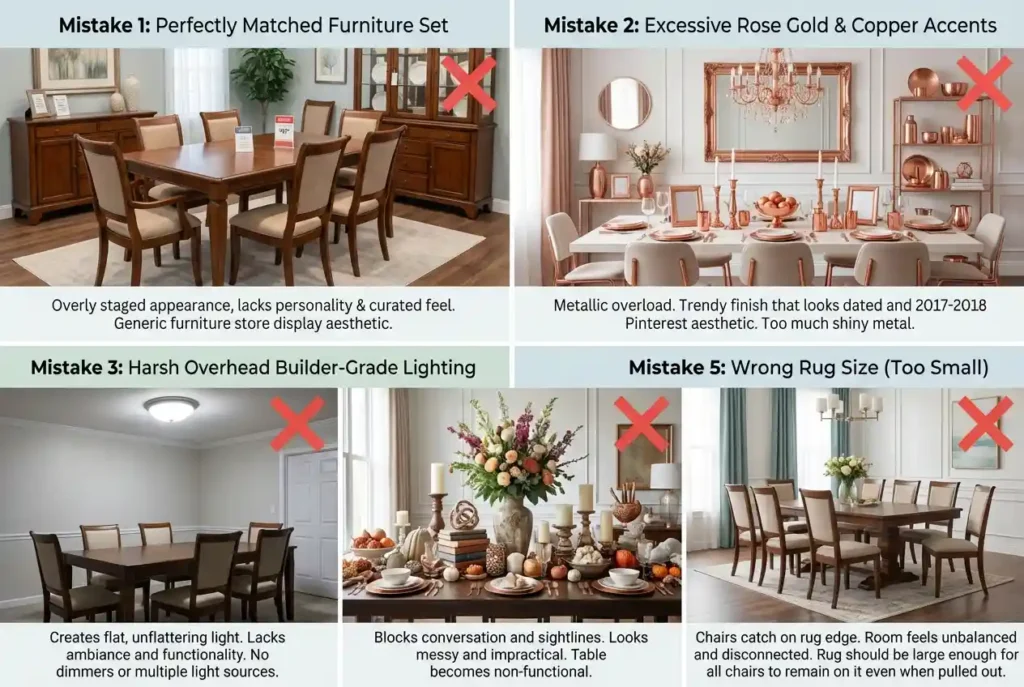
Mistake #1: I Matched Everything
My first dining room was all from the same store, same collection, same finish. It looked like a catalog page—and not in a good way.
The fix: the 80/20 rule. Eighty percent of your room should feel cohesive (same color family, similar style), but 20% should be a little off. Maybe that’s one vintage chair, a different wood tone on the sideboard, or a rug with an unexpected pop of color.
Perfection looks staged. Near-perfection looks designed.
Mistake #2: I Went Full IKEA (And It Showed)
Look, I love IKEA—but if every single piece is from there, people can tell.
The pieces that scream budget: basic table legs, plastic chair backs, particle board, anything. The pieces that look expensive: SINNERLIG pendant lights, STOCKHOLM furniture line, anything with real wood or brass.
The move: use IKEA for 60% of the room max, then bring in one or two pieces from elsewhere. That sideboard I refinished? Makes everything else look more intentional.
Mistake #3: I Skipped the Rug (Dumb)
I thought rugs were optional. They are not.
Without a rug, the table and chairs just float in the room like they’re waiting for someone to arrange them. A rug anchors everything and makes the space feel finished.
Plus—and I learned this after my daughter spilled an entire bowl of marinara—washable rugs are the only way to go if you have kids or pets. That Ruggable saved me from a full-on panic attack.
Mistake #4: I Bought Rose Gold Everything (It Was 2019)
Trendy metals date your room faster than anything else.
Rose gold, copper, and black matte were EVERYWHERE in 2,019 and now they look as dated as those live-laugh-love signs. If I could redo my first attempt, I’d stick with brass or brushed nickel—they’ve been around for decades, es and they’ll stick around for decades more.
When you’re spending money, ask yourself: “Will this look good in 10 years?” If the answer is “maybe,” skip it.
Mistake #5: I Only Had Overhead Lighting
One ceiling light made dinner feel like an interrogation.
The room was either too bright (harsh shadows, everyone looked exhausted) or too dark (couldn’t see your food). There was no in-between until I added lamps and installed a dimmer.
Now I can set the mood without buying new fixtures. Honestly, that dimmer was life-changing.
Making IKEA Look High-End (Specific Hacks)
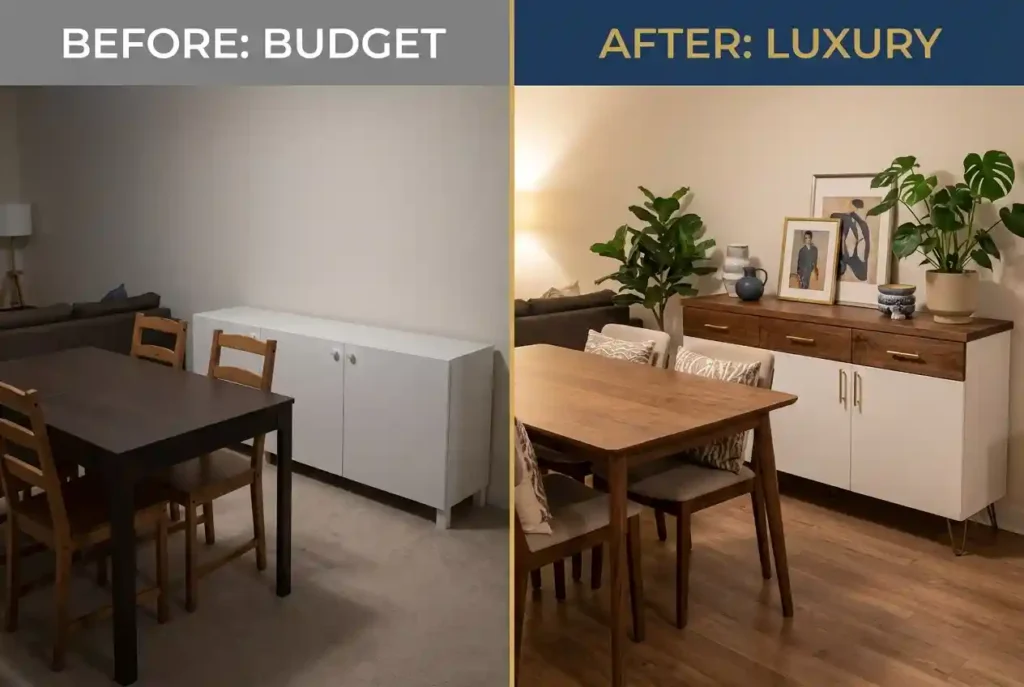
Want to use IKEA but don’t want it to look obvious? Here’s exactly what I did.
EKEDALEN Table: Swap the blocky legs for tapered mid-century legs from Amazon (search “furniture legs 16 inch tapered”). Takes 20 minutes and makes the table look custom.
TOBIAS Ghost Chairs: Add linen seat cushions from Target ($12 each). Suddenly they’re not “cheap clear plastic”—they’re “contemporary acrylic seating.”
BESTÅ Storage: Use this as a sideboard base. Add a wood top (cut to size at Home Depot for $30), replace the handles with leather pulls ($25 on Etsy), and now you’ve got a $600-looking sideboard for $200 total.
SINNERLIG Pendant: If you’re not splurging on the chandelier, this is your move. It’s woven, textural, and looks way more expensive than $70. Get it in the natural finish, not black.
The trick with IKEA: swap out anything plastic, replace all the hardware, and mix it with one non-IKEA piece. That’s the whole game.
Renter-Friendly Alternatives (For Every Permanent Fix)
Can’t install stuff? I got you.
| Permanent Solution | Renter-Friendly Alternative |
|---|---|
| Hardwired chandelier | Plug-in pendant with swag hook ($8 at Home Depot) |
| Paint walls | Peel-and-stick wallpaper accent wall (Target, $45/roll) |
| Install sconces | Battery-operated picture lights or plug-in wall lamps |
| Replace flooring | Oversized area rug (hides ugly carpet) |
| Built-in shelving | Freestanding bookcase as a room divider |
I’ve lived in five rentals, and these tricks work every single time. The plug-in pendant, especially—I’ve taken the same light fixture to three apartments, and it looks built-in at all of them.
My Actual Timeline (Order of Operations)
Week 1: Measure your room and figure out what size table fits. Don’t skip this—I once bought a table that was six inches too long and had to return it.
Week 1-2: Pick your paint color and light fixture. These set the tone for everything else. Order the light so it arrives by Week 5.
Week 2-4: Hunt for your table and chairs. This is the longest part because you’re looking for deals. Check Facebook Marketplace daily, hit up estate sales on weekends, and browse IKEA clearance.
Week 5 (Weekend): Paint the walls. It’s messy but fast—one weekend if you’ve got help.
Week 5-6: Install or hang the light fixture. If you’re hardwiring, hire an electrician (mine charged $120). If you’re doing plug-in, this takes 20 minutes.
Week 6: Arrange furniture and lay the rug. Step back. Adjust. This is where you realize if something’s too big or too small.
Week 7: Add the finishing touches—art, plants, decor. Don’t rush this part. Living in the room for a few days before you finalize.
Real talk: mine took three months because I was picky about finding the right secondhand sideboard, and I waited for a West Elm sale on the chandelier. If you buy everything new and don’t wait for deals, you could do this in four weeks.
FAQ
Can you mix modern dining furniture with a traditional house?
Absolutely, and it actually works better than you’d think. Modern furniture softens traditional architecture (crown molding, wainscoting) and keeps it from feeling too formal. I have a friend with a 1920s Craftsman bungalow who put a sleek walnut table and ghost chairs in her dining room, and the contrast is gorgeous. The key: keep your modern pieces warm-toned (wood, brass) instead of cold-toned (chrome, glass). And add one traditional element, maybe vintage art or an antique rug, to bridge the gap.
What’s the real difference between modern and contemporary for dining rooms?
Modern = a specific style from the mid-20th century (think 1950s-60s). Clean lines, organic shapes, wood and leather, function over form. Contemporary = whatever’s current right now, which means it changes every few years. In 2026, contemporary dining rooms mix styles—modern table, vintage chairs, and industrial lighting. If someone’s selling you a “modern” dining set and it’s all sleek glass and chrome, they actually mean contemporary. True mid-century modern is warmer and wood-heavy.
How do you make a modern dining room cozy for everyday family meals?
The secret’s in the details nobody photographs for Instagram. Keep a linen table runner on the table at all times, not just for guests. Put a bowl of fruit or a small plant as a permanent centerpiece so the table never looks bare. Use cloth napkins in a basket instead of hiding them in a drawer; it signals “we eat here,” not “this is for show.” Swap out dining chairs for a bench on one side if you have kids (more casual, easier to squeeze in). And use your chandelier dimmer for every meal, 50% brightness makes everything feel intentional.
Is it tacky to use all Target or IKEA furniture?
Not if you style it right. The trick is breaking the sameness; if every piece is from one store, it reads like a dorm room. Use IKEA for the bones (table, storage), Target for the soft stuff (chairs, decor), and bring in one wildcard from somewhere else (secondhand sideboard, vintage art, splurge chandelier). Also, swap out hardware and add texture. An IKEA table with new legs and a linen runner doesn’t look like IKEA anymore. The biggest tell is leaving things stock; if it looks exactly like the catalog photo, people will recognize it.
What’s the smartest budget split for a $1,500 dining room?
Spend 25% on lighting ($375), 40% on table and chairs ($600 total), 15% on a rug ($225), 10% on storage ($150), and 10% on decor and finishing touches ($150). This prioritizes the big visual impact (that light fixture) while leaving enough for functional basics. If you go over on lighting, as I did, make up the difference by shopping secondhand for the table or chairs. But never, ever cheap out on the light. A $100 chandelier makes a $500 table look like $200. A $400 chandelier makes a $200 table look like $600.
My Honest Take
After two failed attempts and way too many Saturday mornings at estate sales, I’d do this exact room again in a heartbeat. The biggest lesson: one stunning light fixture beats five mediocre furniture purchases every single time. Start there, get scrappy with everything else, and you’ll end up with a dining room that actually feels like yours—not a showroom you’re afraid to touch